Proud Member of the Rapid Response Team for:

Click Here To Learn More About How You Can Help
Or
Call 412-378-8779
Categories
- 2012
- 2013
- 2016
- 2017
- 2018
- Advertising
- Advocacy
- Amazing!
- Appellate Practice
- Apps for Lawyers and Others
- AVVO Answers
- Bankruptcy
- Blawging
- Business
- Casa San Jose
- Case Update
- Christmas!
- Civil Litigation
- Civil Rights
- Civility and Courtesy in the Practice of Law.
- Congressional Redistricting
- Constitutional Law
- Construction Law
- Consumer Protection
- Contract Law
- Coronavirus
- Courthouse Scenes
- COVID-19
- Credit Card Collection Litigation
- Criminal Law
- Cyber security
- Decision making
- Employment Law
- Encore Post
- Environmental Law
- Estates and Trusts
- Ethics
- Evidence
- Fair Housing
- Fake News
- Family Law
- Fifty Years Ago
- fracking
- Future of the Law
- Great Lawyers
- History
- Holidays
- How to . . .
- Humor and Satire
- Immigration
- insurance
- Jack Sez
- Landlord and Tenant law and litigation
- Lawyering
- Legal Education
- Legal Ethics
- Legal History
- Legal Marketing
- Legal Technology
- Legal Writing
- Life Affirmation
- Life on the Internet
- Links
- Milestones
- Mortgage Foreclosure
- News Commentary
- Oil and Gas
- On line chicanery
- On-line Security
- One Hundred Years Ago
- Oriegate
- Orphan's Court Practice
- Personal Privacy
- Personal Productivity
- Phishing
- Pittsburgh
- Pittsburgh Legal Back Talk
- Pittsburgh Legal Community
- Pokemon Litigation
- Politics and Government
- Post September 11
- Practice of Law
- Privacy
- Property Assessments
- Real Estate
- Real Estate Contracts
- Reassessment 2012
- Retweets
- Right to Reputation
- SCOTUS
- Screenshots!
- Security and Privacy
- Senior Lawyers
- Seven Foundations of Time Mastery for Attorneys
- Signs of the Times
- Solo by Choice: The Review
- Tell Us Something . . .
- Ten Years of Pittsburgh Legal Back Talk
- Tenth Anniversary
- Tenth Anniversary Year of PLBT
- The continuing American Revolution
- the Review
- trademark and service mark
- Trends in the Law
- UTPCPL
- Vocabulary Word of the Day
- Weekend Book Review
- Winners and Losers
- Words Lawyers Use
- Workers Compensation
- Zoning
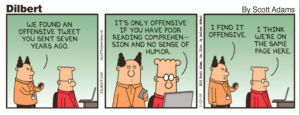
Those tweets that were so funny back in the day — they never go away.
Posted by Cliff Tuttle| January 13, 2018 | © 2026
No. 1,394
I noticed a lot of cutting-edge stuff on Twitter last night involving the shithole controversy. Some are really funny. However, before jumping in, bear in mind that tweets never go away. Anybody can look up your account and see everything you ever tweeted. That includes future employers, future girlfriends and boyfriends, the police, litigants, political opponents and other enemies. By then, the context may be lost. Or by then, you may have grown up a little. As I noted in the last post, below, words have consequences.
Everything You Ever Wanted to Know About the Word “Shithole.”
Posted by Cliff Tuttle| January 13, 2018 | © 2026
No. 1,393
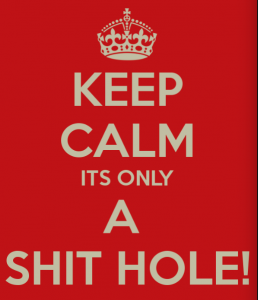
This one was too good to pass up.
As explained by retired law professor Ann Althouse in her blog post, this word has a long and storied history. I used to think it was an epithet not suitable for polite conversation. But not anymore. After all, it has been used in literature since the 17th Century, at least. I must admit, no other word in the lexicon captures the meaning so vividly. Nevertheless, be careful. There are limits. Reminds me of a story from my days as a young (and very proper) lawyer in a straight laced law firm.
Years ago, before the age when lawyers began to type their own correspondence on personal computers, I had an opposing counsel who was in-house at a government agency. He dictated a lot of long florid letters that were typed by a secretary. She told her co-workers that he never proofread anything. To illustrate the point, she typed an extra word on the end of a particularly long letter to me. The last sentence read something like this: “Pleased be advised that we will be taking appropriate action, asshole.”
He signed the letter, of course, without reading it. The plan was to show it around his office so everybody could have big laugh. Unfortunately, the letter and several cc’s went out in the mail. The secretary, who called me to apologize, stated that she was a single mother and was being fired. Words can have consequences.
Here’s the post from Althouse.
CLT
Excellent Advice Worth Retweeting.
Posted by Cliff Tuttle| January 13, 2018 | © 2026
No. 1,392
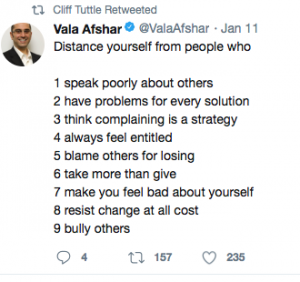
From Twitter
Here’s the companion tweet:
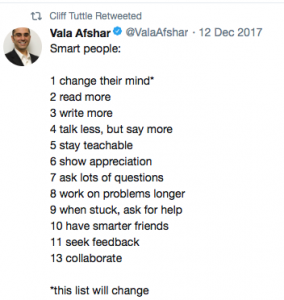
Ok, Admit It! You Think You’re a Genius Too, But You Won’t Say So In Public.
Posted by Cliff Tuttle| January 6, 2018 | © 2026
No. 1,391

Image: Huffington Post
Donald Trump probably should have just ignored the publication of “Fire and Fury: Inside the Trump White House”, but that would have been out of character. This President strikes back when criticized and this occasion would be no exception.
Michael Wolff portrayed him as a low-intellect, television watching, undisciplined and incompetent man-child without the ability or inclination to engage in the work of the presidency. His response betrayed that he was deeply stung.
Who among us wouldn’t be? How would you like to be characterized as a big dummy? After all, he pointed out he had been a good student (went to Wharton) and became a billionaire and a TV star. And then he said the words that will be hung around his neck forever: “stable genius.”
Bad move. Dumb move, even.
But understandable. Don’t we all harbor some modicum of secret vanity in this realm? We think we’re smarter than most of the people around us, but we’re sure as heck not going to tell them. We’re not that stupid.
Smart or smarter is one thing. But what is genius?
If you look it up, Google will lead you to sites which will tell you that a measured IQ of 145 or higher classifies as genius. If you test that high, that score puts you in the top 1%. At that level, I have heard it said, you can learn anything you want.
But, as we all know, everybody isn’t equally capable in every discipline. Some few of us can fix anything mechanical. Some can learn foreign languages quickly and easily. Some can play musical instruments or paint portraits. Some can rapidly do complicated math problems without paper or pencil. Very few, even the most capable, can do it all.
And then, there is the mystery of creativity. We all remember a classmate in school who was a learning machine, capable of rote learning in prodigious quantities, but who rarely had a truly original thought.
I suggest that one aspect of genius (but not the only one) is the ability to solve difficult problems that have stumped others. We are not talking about mere riddles or brain-teasers here. The solutions frequently are original and creative. Yes, outside the box. These solutions can even be revolutionary. And why not? If the answer could be obtained by a lot of hard work or even long hours, somebody would have come up with it.
Genius is without precedent.
Napoleon was capable of making brilliant and unexpected moves on the battlefield in a glance. There was no science of military strategy then in existence that explained why he did what he did. He did it naturally, intuitively. And so with others: Leonardo, Newton, Einstein. They jumped effortlessly (or so we think) from one mountaintop to the next, without the need to follow the same path down and up the mountain that the rest of us must walk.
And so, does Trump qualify as a genius by this test? Maybe.
There is a certain resemblance to the Napoleonic style in Trump. He managed to figure out how to build Trump Tower in Manhattan with an array of powerful opposition fighting him on every side. If you read the Art of the Deal, you have to be impressed with his problem-solving ingenuity, paired with an unlimited supply of self-confidence and persistence. Yes, he made mistakes, big ones. Yes, he failed in many endeavors, lots of them. However, geniuses fail, too. In the end he seems to have figured out ways to survive and then to prosper.
This supreme egotist has publicly calls himself a genius. But that is only the latest in a series of audacious moves that he has dared to make. Meanwhile, the rest of us have played it safe. There’s a word for that: mediocre.
After all, genius is without precedent.
CLT
Signs of the Times: Is it Either or Both?
Posted by Cliff Tuttle| January 3, 2018 | © 2026
No. 1,390

Do Federal District Law Clerks Have Too Much Power?
Posted by Cliff Tuttle| January 2, 2018 | © 2026
No. 1,389

Image: americanbar.org
Eric Segall, a law professor with clerking experience, says that this is the case. Although we always suspected the clerk decided at least some of our motions, Segall says that the situation is a lot worse than you probably think. A must read from Dorf on Law Blog for civil litigators.
CLT
Darkness at the Corner of Walk and Don’t Walk: Goodbye KQV!
Posted by Cliff Tuttle| December 31, 2017 | © 2026
No. 1,388
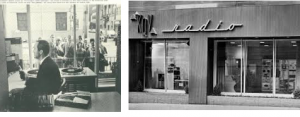
Image: Google
Goodbye to Pioneering Radio Station KQV. It was one of a handful stations like KDKA and WWSW that people listened to on crystal sets in the early 1920’s. After a 97 year run, it goes off the air tonight at midnight.
Although it has been an all-news station since 1975, the Baby Boomer generation remembers it as the place to hear Top Forty songs by the likes of the Everly Brothers and features like the Wax to Watch.
KQV constantly had its finger on the pulse of the teenage market. They broadcast “Live News at 55” so they could capture dial-searchers at the top of the hour. (Later competitors would dispense with news altogether.) And if you didn’t get the Walk and Don’t Walk reference, don”t worry, you just aren’t old enough. In those days, the DJ broadcast all day in the window, looking out on the pedestrian crosswalk on Seventh Avenue.
CLT
Sign of the Times.
Posted by Cliff Tuttle| December 30, 2017 | © 2026
No. 1,387

Image: busblog
POLITICAL JUNKIE ALERT: CONGRESSIONAL REDISTRICTING COMES TO THE PA SUPREME COURT.
Posted by Cliff Tuttle| December 30, 2017 | © 2026
No. 1,387
LEAGUE OF WOMEN VOTERS OF PA, ET AL. v. COMMONWEALTH OF PENNSYLVANIA ET EL., NO. 261 M.D. 2017
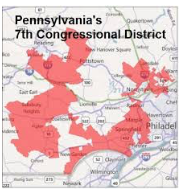
Image: dailykos.com
The Pennsylvania Supreme Court directed Judge Kenneth Brobson of the Commonwealth Court to conduct a non-jury trial and to find facts and recommend conclusions of law regarding the claim of the Petitioners, who included various registered voters in the Democratic Party, that the legislative reapportionment of Pennsylvania’s 18 congressional districts was unconstitutional.
Judge Brobson concluded that the Petitioners have established by a preponderance of the evidence that the redistricting plan was motivated by partisan considerations, which enabled the Republicans to consistently win 13 out of 18 congressional seats. However, while characterizing the method of redistricting as unfair, “Petitioners have not articulated a judicially manageable standard by which this Court can discern whether the 2011 Plan crosses the line between permissible partisan considerations and unconstitutional partisan gerrymandering under the Pennsylvania Constitution.”
In addition, the Petitioners did not present evidence that the redistricting plan constituted an act of retaliation against political opponents, one of the criteria for unconstitutional gerrymandering established in prior caselaw.
“A lot can be said about the 2011 Plan,” the opinion states, “much of which is unflattering yet justified. Petitioners, however, have failed to meet their burden of proving that the 2011 Plan, as a piece of legislation, clearly, plainly, and palpably violates the Pennsylvania Constitution. For the judiciary, this should be the end of the inquiry.”
While this conclusion is based upon Judge Brabson’s assessment of the current state of the law, two cases are pending before the United States Supreme Court that could change everything. In the case of Gill v. Whitford, the Supreme Court has stayed the implementation of the decision of the United States District Court for the Western District of Wisconsin that a plan in that State violates the pending disposition of the appeal to that Court. See 137 S. Ct. 2289 (2017).In Benisek v. Lamone, the Supreme Court will consider a claim from Maryland brought under the FirstAmendment, including a retaliation allegation.
Under these circumstances, the Pennsylvania Supreme Court might well postpone consideration of this case until after the U.S. Supreme Court takes action in 2018.
CLT
Tags: congressional redistricting > Gerrymandering > Judge Kenneth Brobson > Pennsylvania Constitution
Lawyers Spoof Lawyers’ Writing Style. But Do They Stop Doing It?
Posted by Cliff Tuttle| December 29, 2017 | © 2026
No. 1,385
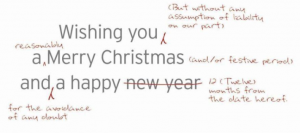
Here’s a Christmas Card that appears on the December 25th post of a blog run by a couple of law professors.
Courtesy of Appellate Advocacy Blog
Yes, everybody recognizes this ludicrous lawyerly writing style. Everybody knows how stilted and pretentious it sounds. Everybody knows that it is an attempt to relieve the writer from liability that would never happen or provide certitude that nobody needs. Everybody laughs at it. But is anybody even trying to stop writing that way?
Or maybe we should say, “Is anybody reasonably trying to stop?”
CLT
« go back — keep looking »
Welcome
CLIFF TUTTLE has been a Pennsylvania lawyer for over 45 years and (inter alia) is a real estate litigator and legal writer. The posts in this blog are intended to provide general information about legal topics of interest to lawyers and consumers with a Pittsburgh and Western Pennsylvania focus. However, this information does not constitute legal advice and there is no lawyer-client relationship created when you read this blog. You are encouraged to leave comments but be aware that posted comments can be read by others. If you wish to contact me in privacy, please use the Contact Form located immediately below this message. I will reply promptly and in strict confidence.
Recent Posts
- Sheriff Sales in the COVID-19 Era
- MORTGAGE FORECLOSURE: Cares Act creates gigantic opportunity for borrows under federally-backed and owned mortgages.
- PA Appellate Courts Schedule Arguments Using Electronic Media
- US Supreme Court holds that juries must render unanimous decisions in state criminal cases
- Signs of the Times — the future shortage of dentists.