Proud Member of the Rapid Response Team for:

Click Here To Learn More About How You Can Help
Or
Call 412-378-8779
Categories
- 2012
- 2013
- 2016
- 2017
- 2018
- Advertising
- Advocacy
- Amazing!
- Appellate Practice
- Apps for Lawyers and Others
- AVVO Answers
- Bankruptcy
- Blawging
- Business
- Casa San Jose
- Case Update
- Christmas!
- Civil Litigation
- Civil Rights
- Civility and Courtesy in the Practice of Law.
- Congressional Redistricting
- Constitutional Law
- Construction Law
- Consumer Protection
- Contract Law
- Coronavirus
- Courthouse Scenes
- COVID-19
- Credit Card Collection Litigation
- Criminal Law
- Cyber security
- Decision making
- Employment Law
- Encore Post
- Environmental Law
- Estates and Trusts
- Ethics
- Evidence
- Fair Housing
- Fake News
- Family Law
- Fifty Years Ago
- fracking
- Future of the Law
- Great Lawyers
- History
- Holidays
- How to . . .
- Humor and Satire
- Immigration
- insurance
- Jack Sez
- Landlord and Tenant law and litigation
- Lawyering
- Legal Education
- Legal Ethics
- Legal History
- Legal Marketing
- Legal Technology
- Legal Writing
- Life Affirmation
- Life on the Internet
- Links
- Milestones
- Mortgage Foreclosure
- News Commentary
- Oil and Gas
- On line chicanery
- On-line Security
- One Hundred Years Ago
- Oriegate
- Orphan's Court Practice
- Personal Privacy
- Personal Productivity
- Phishing
- Pittsburgh
- Pittsburgh Legal Back Talk
- Pittsburgh Legal Community
- Pokemon Litigation
- Politics and Government
- Post September 11
- Practice of Law
- Privacy
- Property Assessments
- Real Estate
- Real Estate Contracts
- Reassessment 2012
- Retweets
- Right to Reputation
- SCOTUS
- Screenshots!
- Security and Privacy
- Senior Lawyers
- Seven Foundations of Time Mastery for Attorneys
- Signs of the Times
- Solo by Choice: The Review
- Tell Us Something . . .
- Ten Years of Pittsburgh Legal Back Talk
- Tenth Anniversary
- Tenth Anniversary Year of PLBT
- The continuing American Revolution
- the Review
- trademark and service mark
- Trends in the Law
- UTPCPL
- Vocabulary Word of the Day
- Weekend Book Review
- Winners and Losers
- Words Lawyers Use
- Workers Compensation
- Zoning
In the Event . . .
Posted by Cliff Tuttle| March 29, 2015 | © 2026
No. 1,132
Sign on inside door in an arbitration room in the Washington County Court House Annex. They have security at the door, but we cannot be too careful.
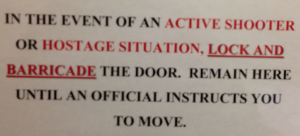
So we can be properly prepared, how do we know if the voice on the other side of the door is an official or a shooter who may be impersonating an official?
Hertz Puts Camera in Cars.
Posted by Cliff Tuttle| March 23, 2015 | © 2026
No. 1,131
Its part of the dashboard electronic set up, pictured below, that helps you make sure you never get lost, even if you want to.
But, Hertz says it is deactivated and it doesn’t plan to use it. Well, that’s comforting. A useless, turned off camera. OK, Big Brother, be sure to give us lots of notice when you change that plan.
Do we have an expectation of privacy in this situation? After all, its their car, not our’s. Hertz is not the government, but the government can subpoena the tapes — if there were tapes, which of course there aren’t.
Don’t feel paranoid or anything, mind you, but you might want to put a small piece of duct tape on the lens. Peace of mind. Then, just in case there’s a recorder in there too, play loud music on the radio. Then drop it off at AVIS. It’s okay, Hertz can find it. GPS is part of the Never Lost package.
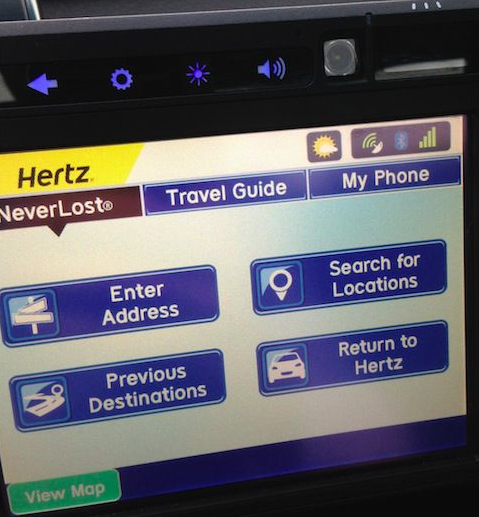
Credit: Fusion (see link).
Link to CFPB Sample Real Estate Closing Forms.
Posted by Cliff Tuttle| March 23, 2015 | © 2026
No. 1,130
Here’s a link to the new sample forms promulgated by the CFPB (Consumer Financial Protection Bureau) for real estate closing disclosures that will be required for loans originated after August 1, 2015.
If you are accustomed to using the HUD 1 settlement statement, you’ll find the essence of it integrated into the various combined Truth in Lending and Real Estate Settlement Procedures Act Disclosures. But the HUD 1 itself will cease to exist.
These documents are intended to make loan disclosures more easily understood. But do they, really? The CFPB thinks they represent an improvement in clarity over prior disclosure forms. And perhaps that is true in the abstract.
But in practice, the typical borrower will zone out somewhere on page 2. People will need to have the information on these forms explained line by line, just as they do now. This used to be done at the closing table. Now, with disclosures being given three days in advance, clients who want understandable explanations of the disclosures may call their lawyers. Even though they are not conducting residential loan closings under the new regime, real estate lawyers should be prepared to assist bewildered borrowers before and perhaps during the closing.
Its too late to complaint. These changes are a done deal, or at least they seem to be. Nevertheless, if history is a reliable guide, the CFPB will postpone the implementation date, possibly more than once.
CLT
Lawton Stokes: How to Maintain a Title Insurance Agency in Changing Times.
Posted by Cliff Tuttle| March 22, 2015 | © 2026
No. 1,129

Lawton Stokes
Real Estate Attorney
You may have heard that things are changing big time in the residential real estate closing business. The operant words here are “big” and “business.” Closing residential loans has become a big business and those who handle closings of residential mortgages are doing it full-time on a large scale. While law firms are not excluded from this arena, most closers are not law firms but are title agencies owned and operated by non-lawyers. The trend has been for lenders to establish in-house title agencies and they have a monopoly in closing their own loans.
Lawton Stokes is an attorney who with his wife Kristin, also an attorney, operates real estate broker Achieve Realty. The Stokes also operate a real estate closing agency which is in the process of transition to the new world of residential real estate loan closings. This transition is not going to be easy, but Stokes says that it can be done.
Q: How has the title insurance business changed in recent years?
1. Pillar No 1: Establish and maintain current license(s) as required to conduct the business of title insurance and settlement services. [Easy.]
2. Pillar No. 2: Adopt and maintain appropriate written procedures and controls for escrow trust accounts allowing for electronic verification of reconciliation. [This should be easy if you currently use title insurance software that creates settlement statements and also handles the accounting function. These companies are all adapting to help their customers meet this requirement. If you don’t have software that does this, you’ll have to obtain it.]
3. Pillar No. 3: Adopt and maintain a written privacy and information security program to protect non-public Personal Information as required by local, state and federal law. [This is a challenge for offices that are not “compartmentalized.” If the public and/or your cleaning staff can access your files, regardless of the time of day, you have to modify your office layout. If you work from home and see no clients at home and conduct your closings away from home, you’re okay as long as you don’t have a cleaning person at your house. If you work from an office, you’ll have to keep the files locked away when you’re not working on them. Furthermore, you’re going to have to encrypt your email. And while you’re at it, encrypt your desk top and your server too.]
4. Pillar No. 4: Adopt standard real estate settlement procedures and policies that help ensure compliance with federal and state consumer financial laws as applicable to the settlement process. [You probably already have these procedures in place. Formalize them.]
5. Pillar No. 5: Adopt and maintain written procedures related to title policy production, delivery, reporting, and premium remittance. [Imagine recording, issuing your title policy and remitting within a maximum of 30-60 days.]
6. Pillar No. 6: Maintain appropriate professional liability insurance and fidelity coverage. [You should already have this.]
7. Pillar No. 7: Adopt and maintain written procedures for resolving consumer complaints. [Easy.]
CLT
Consumer Finance Protection Bureau Posts Complaints on its Blog
Posted by Cliff Tuttle| March 22, 2015 | © 2026
 No. 1128
The Consumer Finance Protection Bureau has been touting the Complaint Department on its Blog.
They encourage consumers to tell their story and promise to forward the matter to the company involved and to give status updates. CFPB has been logging in complaints since July 2011 and says that there are hundreds of thousands of them. (Actually, there are 364,684 of them as of 8 AM on March 22, 2015.)
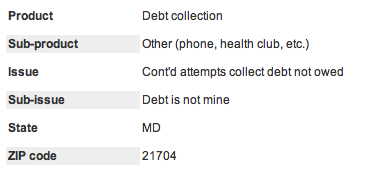
But don’t get too excited. The CFPB didn’t publish 364,684 juicy stories. Its a database and individual entries look (in part) like this:
Landlord & Tenant; Security Deposit; Unfair Trade Practices and Consumer Protection Law.
Posted by Cliff Tuttle| March 16, 2015 | © 2026
No. 1,127

Credit:floridalemonauto.com
A group of students at the University of Pittsburgh entered into a residential lease with Michael Bupp. They paid the first and last month’s rent and a security deposit in advance, for a total of $5,990.00.
The first of the group to move in, Spergel, identified some items in need of repair, including a bath drain, a light, various locks, which he communicated to Bupp by email. Bupp responded with a text message stating: “I cannot deal with your group. Please leave.”
In a telephone conversation which Spergel’s parents heard on the speaker phone, Bupp launch an epic stream of expletives. As a result, Spergel moved out and the others never moved in.
Bupp refused to return the rent and security deposit payments. He stated that they had abandoned the premises despite his promises to perform the repairs.
On appeal from the award of the Arbitrators, a jury entered a verdict for the tenants in the amount of $3,990.00. The trial court thereafter took additional evidence on the Plaintiffs’ claims under the Unfair Trade Practices and Consumer Protection Law. (UTPCPL)
“Based upon this evidence, the trial court molded the verdict to add $10,000 in attorneys’ fees, $457.25 in costs, and $6,010 in exemplary damages. By order dated March 28, 2014, the trial court denied Bupp’s post-trial motions and entered judgment in favor of Appellees in the amount of $20,457.25.”
“Bupp contends that Appellants “offered no evidence that supports the contention that Bupp made misrepresentations to [Appellants] that could in any manner be construed as fraudulent or deceptive.” Bupp’s Brief at 13. Bupp further argues that Appellants “have offered nothing to suggest that Bupp represented he would make repairs and failed to make such repairs,” and that the “uncontroverted testimony at trial” reflects that Appellants ‘were substantially satisfied with the apartment on August 20, 2012, having moved in with no express intention of vacating….’ Id. at 12.”
The Superior Court held that a landlord wrongfully withholding a security deposit constitutes an unfair trade practice under the statute, relying on Wallace v. Pastore, 742 A.2d 1090 (Pa. Super 1999).
CLT
Redacted v. Redacted Will Be Decided By THe PA Supreme Court, No Kidding! Really!
Posted by Cliff Tuttle| March 2, 2015 | © 2026
No. 1,126
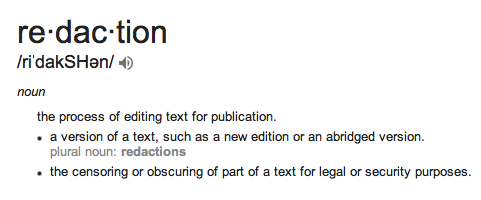
Once again, Howard Bashman of How Appealing has brought to our attention another crazy case. This one is too rich. Now who do you suppose these litigants might be? And how long can the secret be kept?
Give Me A Break, Kevin Durant, Esquire.
Posted by Cliff Tuttle| March 2, 2015 | © 2026
No. 1,125
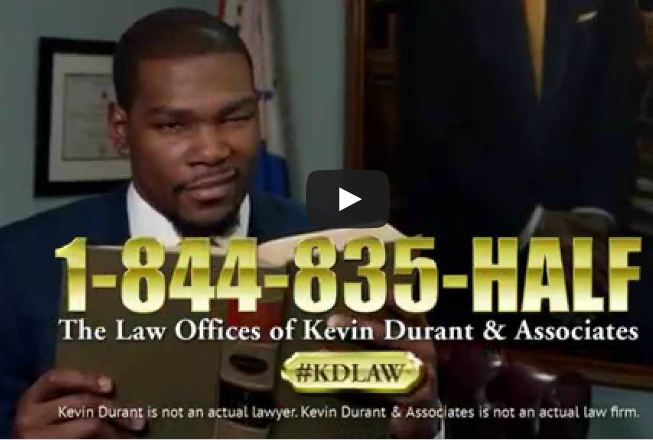
Sprint is responsible for one of the most idiotic commercials on TV today.
Kevin Durant is a professional basketball player, not a lawyer.
He jumps up in court and demands that cell phone bills be cut in half. Then he does it — to the other lawyer’s exhibit. The gallery goes wild. The tipstaff runs over to shake his hand.
But why does Sprint feel compelled to give a credit to the Law Offices Kevin Durant & Associates and disclaim it just below?
Just in Case You’ve Been Distracted by the Academy Awards or Something,
Posted by Cliff Tuttle| February 24, 2015 | © 2026
No. 1,124

Judge Kistler
Image: Pennlive.com
Here’s a news story from the Trib you may have missed about how there probably won’t be any interim nominations this year to the Pennsylvania Supreme Court.
Centre County President Judge Thomas Kistler states that he can’t afford to leave his present position, since the Centre County Common Pleas Court is also short-handed.
So, the deal is off. Nominating just one justice would potentially deadlock the court at 6-6.
However, the Trib article clearly implies that the real reason for the turn-down is that Judge Kistler doesn’t want to be required to explain to the Senate Judiciary Committee why he forwarded a certain Christmas card to his friends in 2013. It shows a black couple hugging during a jail visit and says “Merry Christmas from the Johnsons.”
The Judge acknowledges that he forwarded the card to about 22 people, stating that it illustrates the hardship upon families of incarceration during the holiday. Not surprisingly, there are people who don’t believe that explanation. And some of them would be very happy to testify at the confirmation hearings, inviting the national press to cover the story. The term “media circus” come to mind.
Of course, the Judge, together with his co-nominee, Dean Kenneth Gormley of Duquesne Law School, would almost certainly be confirmed. They have excellent qualifications. But would the game be worth the candle?
CLT
Tags: Dean Ken Gormley > Judge Thomas Kistler > Pennsylvania Supreme Court > Thomas Kistler
Supreme Court Initiates Sanctions Against Lawyer Who Let His Client Tell Him How To State The Argument In A Petition
Posted by Cliff Tuttle| February 22, 2015 | © 2026
No. 1,123
In the Matter of Discipline of Howard Neil Shipley, No. 14D2827.
Image: commdiginews.com
Live long enough and you can see everything.
Every lawyer has had clients who want to micromanage the case. Its a serious handicap. But most of the time, it just makes the task harder.
But not always.
In a rare move, the United States Supreme Court has issued an Order to show cause why sanctions should not be imposed against a lawyer who says that his client insisted upon dictating the content and style of arguments presented in a petition involving a patent matter. The lawyer, Howard Neil Shipley, has had to hire a leading Supreme Court practitioner to plead his case. Of course, being sanctioned by the the United States Supreme Court would be a severe blow to any lawyer’s career.
According to the Response to the Order, recently filed, similar sanctions have not been imposed for 50 years.
Read more about it in the SCOTUS Blog.
CLT
Tags: Order to Show Cause > sanctions against attorney
Welcome
CLIFF TUTTLE has been a Pennsylvania lawyer for over 45 years and (inter alia) is a real estate litigator and legal writer. The posts in this blog are intended to provide general information about legal topics of interest to lawyers and consumers with a Pittsburgh and Western Pennsylvania focus. However, this information does not constitute legal advice and there is no lawyer-client relationship created when you read this blog. You are encouraged to leave comments but be aware that posted comments can be read by others. If you wish to contact me in privacy, please use the Contact Form located immediately below this message. I will reply promptly and in strict confidence.
Recent Posts
- Sheriff Sales in the COVID-19 Era
- MORTGAGE FORECLOSURE: Cares Act creates gigantic opportunity for borrows under federally-backed and owned mortgages.
- PA Appellate Courts Schedule Arguments Using Electronic Media
- US Supreme Court holds that juries must render unanimous decisions in state criminal cases
- Signs of the Times — the future shortage of dentists.