Proud Member of the Rapid Response Team for:

Click Here To Learn More About How You Can Help
Or
Call 412-378-8779
Categories
- 2012
- 2013
- 2016
- 2017
- 2018
- Advertising
- Advocacy
- Amazing!
- Appellate Practice
- Apps for Lawyers and Others
- AVVO Answers
- Bankruptcy
- Blawging
- Business
- Casa San Jose
- Case Update
- Christmas!
- Civil Litigation
- Civil Rights
- Civility and Courtesy in the Practice of Law.
- Congressional Redistricting
- Constitutional Law
- Construction Law
- Consumer Protection
- Contract Law
- Coronavirus
- Courthouse Scenes
- COVID-19
- Credit Card Collection Litigation
- Criminal Law
- Cyber security
- Decision making
- Employment Law
- Encore Post
- Environmental Law
- Estates and Trusts
- Ethics
- Evidence
- Fair Housing
- Fake News
- Family Law
- Fifty Years Ago
- fracking
- Future of the Law
- Great Lawyers
- History
- Holidays
- How to . . .
- Humor and Satire
- Immigration
- insurance
- Jack Sez
- Landlord and Tenant law and litigation
- Lawyering
- Legal Education
- Legal Ethics
- Legal History
- Legal Marketing
- Legal Technology
- Legal Writing
- Life Affirmation
- Life on the Internet
- Links
- Milestones
- Mortgage Foreclosure
- News Commentary
- Oil and Gas
- On line chicanery
- On-line Security
- One Hundred Years Ago
- Oriegate
- Orphan's Court Practice
- Personal Privacy
- Personal Productivity
- Phishing
- Pittsburgh
- Pittsburgh Legal Back Talk
- Pittsburgh Legal Community
- Pokemon Litigation
- Politics and Government
- Post September 11
- Practice of Law
- Privacy
- Property Assessments
- Real Estate
- Real Estate Contracts
- Reassessment 2012
- Retweets
- Right to Reputation
- SCOTUS
- Screenshots!
- Security and Privacy
- Senior Lawyers
- Seven Foundations of Time Mastery for Attorneys
- Signs of the Times
- Solo by Choice: The Review
- Tell Us Something . . .
- Ten Years of Pittsburgh Legal Back Talk
- Tenth Anniversary
- Tenth Anniversary Year of PLBT
- The continuing American Revolution
- the Review
- trademark and service mark
- Trends in the Law
- UTPCPL
- Vocabulary Word of the Day
- Weekend Book Review
- Winners and Losers
- Words Lawyers Use
- Workers Compensation
- Zoning
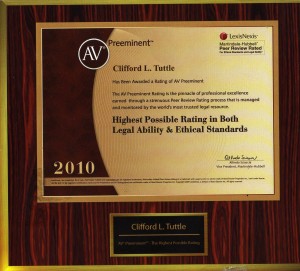
Thank You, Martindale Hubbell.
Posted by Cliff Tuttle| May 12, 2010 | © 2026
EXCUSE ME, EVERYBODY, BUT A SUSPECT IS STILL JUST A SUSPECT: LIMITING MIRANDA.
Posted by Cliff Tuttle| May 11, 2010 | © 2026
Stung by criticism over Miranda warnings given to the “Christmas Bomber”, there is a movement afoot in Congress ( see Jurist article for details) to “limit” the rights of a suspected terrorist to be made aware of the right to counsel before self-incriminating statements. The Miranda warning, familiar to everyone who watches crime shows on TV, is the way our courts ensure that a citizen is made aware of his rights under the United States Constitution.
Yes, there may be compelling safety reasons justifying an immediate interrogation. And yes, the introduction of the ideas contained in the Miranda warning may inhibit the suspect from relating important details of an ongoing conspiracy involving threat to human life. But, if such information must be obtained, not using it to convict is the price that the Fifth Amendment assesses on police seeking to protect both society and the accused.
The reported strategy of the legislation — to “strip” the suspect of US citizenship because of the nature of the charges — is constitutionally untenable because it deprives a citizen of valuable rights without due process, also the Fifth Amendment.
I will bet the first person to contact me with a contrary comment, a month of (modestly priced) lunches that any legislation seeking to permit a citizen to be convicted on a confession deliberately obtained without a Miranda warning will not make it past the United States Supreme Court, regardless of the ideological composition of the Court at the time.
CLT
LANDLORD & TENANT: PROPERTY LEFT AFTER TENANT DEPARTS.
Posted by Cliff Tuttle| May 9, 2010 | © 2026
Many landlords are concerned over what to do when the tenant moves and leaves certain property behind.
This situation is often addressed in the lease. For example, the Pa. Association of Realtors Residential Lease states:
“Any of Tenant’s personal property or possessions remaining on the property after Tenant moves out will be considered to be abandoned property. Landlord will have the right to remove and dispose of any abandoned property in any manner determined by Landlord. Tenant will pay for the cost of removal and disposal of abandoned property.”
Although such a provision would ordinarily solve the problem, there are situations where such a lease provision may not apply.
If the Tenant was constructively evicted — say, by turning off the heat in winter — the landlord would dispose of the tenant’s property at his peril.
Or if the landlord and tenant discussed the tenant returning to pick up the property, but doesn’t, this could cause problems without a written agreement that covers the contingencies. For example, what happens if the tenant doesn’t come back in the stated time period? May the landlord keep the property? Sell it? Throw it in the dumpster? Put it in storage and charge the tenant?
If the tenant comes to you, the landlord, with such a request, get it in writing. Then prepare a written response setting forth the answers to the above questions and get a copy signed by the tenant.
I answered a question on AVVO Answers recently that illustrates the kind of situation that can develop. The tenant erected an awning over the patio of a rented house. When the tenant moved he told the landlord that he would be back in a week or two to pick it up. Three months later, the tenant wants the awning, but the landlord rented the unit to a new tenant that is using the patio with the awning.
Such a situation leaves the landlord needlessly in the middle. The old tenant should have signed a written agreement setting limitations on the right to remove property left behind. Or the new tenant could have been informed in writing that the awning might be reclaimed by the old tenant. Or both.
Riders should be drafted to standard leases to deal with situations that could arise. Otherwise, the parties are forced to take their chances in court and, depending upon the facts, either one may have an expensive loss to absorb. One important purpose of written contracts is to reduce risk, especially when the risk is foreseeable. And the landlord doesn’t have to be the moving party. Tenants can and should propose contract modifications that address their concerns at the time the contract commences. Later may be too late.
CLT
In the Matter of George B. Vashon: Righting Wrongs.
Posted by Cliff Tuttle| May 8, 2010 | © 2026
The Pennsylvania Supreme Court, on motion of Pittsburgh Attorney Wendell Freeman, admitted George B. Vashon to the Bar. He was denied the right to apply for membership in the Allegheny County Bar Association in 1847 on account of his race, as set forth in the following opinion:
| IN THE MATTER OF GEORGE B. VASHON, DECEASED; PETITION OF: NOLAN N. ATKINSON AND PAUL N.D. THORNELL |
| SUPREME COURT OF PENNSYLVANIA |
| May 4, 2010, Decided |
| OPINION
[*1] ORDER PER CURIAM AND NOW, this 4th day of May, 2010, upon consideration of the Petition filed by Wendell Freeland, Esquire, on behalf of the family of George B. Vashon, this Court recognizes that George B. Vashon possessed the necessary credentials, competency, and good character to practice law in Pennsylvania in 1847 based upon his bachelor and masters degrees from Oberlin College, his mentorship with the Honorable Walter Forward of the Allegheny County Court of Common Pleas and his subsequent admissions to practice law in the State of New York and before the U.S. Supreme Court. This Court further acknowledges that Article V, Section 10 of the existing Pennsylvania Constitution gives the Pennsylvania Supreme Court the exclusive authority to prescribe the general rules governing admission to the Pennsylvania Bar and to regulate the practice of law. This Court further recognizes that Mr. Vashon applied for admission to practice before the Allegheny County Bar in 1847 (which appears to have been a prerequisite to practice before this Court), but the examining committee refused to consider his application solely on the basis that he was African-American and therefore could not vote, noting [*2]that the revision to the Pennsylvania Constitution of 1838 only extended voting rights to “every white freeman.” Such discrimination, of course, would be intolerable today. In acknowledgement of Mr. Vashon’s credentials and achievements, this Court hereby admits George B. Vashon to the practice of law in the Courts of this Commonwealth posthumously. Furthermore, Wendell Freeland, Esquire, and the family members of George B. Vashon are hereby invited to be present at a session of this Court during which this Court will confirm its acknowledgment of George B. Vashon’s qualifications to practice law. The Prothonotary is instructed to contact counsel to make any desired and necessary arrangements so that the presentation can be made in open Court, during a convenient session of the Court. It is so ordered. Additional information is contained in the following article that appears in the Pittsburgh Channel website. |
Join Network Pittsburgh and Get Connected.
Posted by Cliff Tuttle| May 8, 2010 | © 2026
| Network Pittsburgh is a rapidly growing networking group for Pittsburgh professionals, operating as a Linked In group. It is an umbrella for a number of other groups which have events going on quite frequently.
Pittsburgh Legal Back Talk appears as a regular blog on Network Pittsburgh as “Pittsburgh Legal.” But sometimes I post articles just for the Network Pittsburgh readers. Network Pittsburgh is still a pretty new organization, coming up on its first anniversary. It has 750 members and is working on getting 1,000. Here is a post that has been appearing in the email newsletter. |
|
| Started by Bruce Rowles, Sr. Recruiter at Manpower Professional | |
| Currently we have almost 750 members and need your help. (Our Main Site http://bit.ly/ceyrST ). We have now been active and networking for almost a year – our goal was 1,000 active members, Networking in the Pittsburgh Area, by the end of May.
Click here to join and sign-up ( http://bit.ly/b9Ve04 ) Thanks for the help and support over the last 11 months +++ Also – we have Networking Events almost daily – http://bit.ly/cR6CG9 +++ Click here for the HTML Link, 10 best Websites in Pittsburgh Contest – to link directly to the Winners – http://bit.ly/aM7MyW |
|
LANDLORD & TENANT: Can You Terminate the Lease When a Fellow Tenant Makes Serious Threats?
Posted by Cliff Tuttle| May 6, 2010 | © 2026
A resident of Bristol, PA posted the following question on the AVVO website:
How can I break lease and get security deposit back being threated by other tenants due to my race? Cops and landlord made aware.
How can I break my lease and get my deposit back. I no longer feel safe where I reside. I was threaten by an upstair tenant that she would have someone break into my home and kill me cause I am a in her words “Spic”. I no longer feel safe in my home. I made the landlord aware of the threat. The cops were also told; however, the town in which I live some of the cops don’t like minorities to much. What can I do?? I need help to be able to break my lease and find a safe place where I can live and not have a problem because I am a minority.
Here is the answer I posted in reply:
Take a look at your lease. Many leases say that you have a right to quiet enjoyment of the premises and even if it does not, it is implied under the law. Write a letter to your landlord and request to be let out of the lease, stating the same reasons set forth above. Keep a copy. Perhaps your landlord will let you move to another building.
If you have no success, you may wish send a notice declaring the lease terminated and simply move. Send this notice certified mail and keep a copy, together will the certified mail receipts. After you move, send another letter well within 30 days containing your new address and requesting the deposit.
Now, you may have to go to the magistrate’s office to defend yourself at a hearing and you may just lose the case. You then will have to decide whether to appeal to arbitration. Of course, if you win at the magistrate’s, the landlord might appeal. And you both have the right to appeal to a judge after the arbitration decision.
In short, you are going to have to be willing to take a risk that you might lose. Whether you win or lose is going to depend a great deal on how convincing your evidence is. It would certainly help to have a good corroborating witness.
Prejudice Around Us.
Posted by Cliff Tuttle| May 3, 2010 | © 2026
The word prejudice means to pre-judge. We see it everywhere we look, but don’t call it what it is. Talk radio is full of it. Hosts and callers are continuously reaching conclusions based upon very little evidence. This includes cases coming up for trial. In most cases, the evidence to be presented at the trial, especially the defense, is unknown or at best speculative.
But can the refusal to pre-judge a matter before the evidence is in be a form of prejudice? In some people’s view it can. Consider the case of the Harvard third year law student who wrote an email saying that she won’t dismiss the possibility that genetic studies will ultimately determine that there is a racial component to intelligence.
When Above the Law reported the story, but didn’t reveal the name of the email’s author, others hunted her down. The headline in a tabloid on line publication called “Jezabel” tells it all: “Meet Harvard’s Racist Email Antagonist.”
The ability to withhold judgment when all of the evidence has not been collected is one of the skills that you learn in law school. But anyone can and should learn this fundamental mental discipline. When you withhold judgment until the appropriate time, you frequently discover that the answer is more complicated than previously thought and sometimes quite different from any of those previously suggested.
The mysteries of the human brain, how it really works and what it is capable of doing are being discovered at a rapid rate. But it is safe to say that we still know far less than we don’t know. We might as well admit it. The alternative is a high probability of being wrong.
CLT
Weekend Book Review: “The Reluctant Rainmaker” by Julie A. Fleming, JD
Posted by Cliff Tuttle| May 2, 2010 | © 2026
Rainmakers used to be considered to be born, not made. Some people just had what it took to schmooze clients. These were usually the seniors in the firm, while the juniors were expected to keep their shoulders to the wheel.
No longer. Not for a long time.
Somewhere in the latter part of the 20th Century, firms started telling their juniors that they were being expected (not merely encouraged) to attract business to the firm. And, this activity was to be in addition to billing the required number of hours and frequently without the financial support of the firm.
Ever since, lawyers have been trying to figure out how to do it. Rainmaking is just another one of the countless responsibilities that lawyers must face and master.
This need to market, made acute by economic downturns and increasingly stifling competition, has spawned an industry. There are lots of experts who will gladly advise you how to build your practice . . . for a fee. So where do you turn?
If you could only afford one book on legal marketing (no kidding!) , Julie A. Fleming’s “Reluctant Rainmaker” should be that book. It is complete, yet concise, organized and very readable. It can be read from cover to cover or topically.
Here are a few samples, chosen at random:
“I have never had a single lawyer tell me that he went to law school to bring in business. Not one person has told me about the joys of networking, the pleasures of asking for business, or the delights of building a book of business. Make no mistake, clients are often at the heart of a lawyer’s reason for being in practice, because lawyers often do want to help others. But getting the clients and having the work to do is always assumed. It is a shadowy, rarely considered aspect of practice for those who are deciding to be lawyers, and not much more for those in law school.”
****************
“Daily activity: Complete one business development task every single day. These tasks can vary between quick and easy(making a phone call to check in with a client or referral source) to protracted and challenging (setting aside four hours to work on an article related to your practice area). The benefit of daily activity is that you chip away at your task list, and missing a single day does little to compromise your progress.”
*******
“One complaint that clients often have is that some lawyers take on the role of the expert too quickly, offering solutions before fully appreciating the problem or the desired outcome. You will be most effective in offering assistance if you first ask questions and then listen carefully to the answers you receive. Listening telegraphs that you respect the speaker and want the information he is conveying, and it creates the impression that you are seeking to understand what your conversational partner needs. . . . And by ensuring that you understand before you speak, you will distinguish yourself from other lawyers without even opening your mouth.”
********
“Cliches are repeated because they are true, and the old saw that failing to plan is planning to fail is a time-tested truth. If you are a reluctant rainmaker who has decided that now is the time to get started, you may be tempted to skip the planning step and jump into action. Doing so almost guaranties that your activity will be poorly focused and that your results will be scattershot.”
*******
“A website is now an absolute necessity for every law firm and sole practitioner. . . . You can spend a great deal of time and money building an attractive site, but your emphasis should be on building a site that is effective for providing information and demonstrating to potential clients that you have substantial expertise. ”
*******
“Activities with clients are the most valuable activities you can do. Whenever you have contact with a client you have an opportunity to engge in business development. Your client already knows, and one would hope, likes and trusts you. The more you can do to develop that relationship through excellent client service and perhaps business/social activity, the more likely you are to retain that client’s business and to receive more business and referrals from that client.”
Well, that’s enough to get the idea. I purchased it on Kindle, so that I would have it available for periodic re-reading and browsing. I can also use it for reference, either by using the Table of Contents (which is well-drawn) or through the word search function in Kindle. I can also make notes in a Kindle book. The only drawback is that Kindle does not capture the graphical design and certain parts may be a bit confusing.
I give Reluctant Rainmaker five stars.
CLT
Scavenger Wars
Posted by Cliff Tuttle| April 22, 2010 | © 2026
If you have an old unpaid credit card, you should be aware that it is becoming a common practice for the lenders to bundle up delinquent accounts and sell them in bulk to investors. These accounts are typically sold for pennies on the dollar. The new owners will then carpet bomb the debtors with phone calls, hoping to get lucky. There is a reason we call them scavengers.
If one of them suggests making a very small payment as a token of good faith, it may be a ploy to revive a claim that is beyond the statute of limitations. These collectors are usually not above utilizing unethical and even illegal means to collect money.
For starters, the mere fact that these anonymous callers know the details of your account doesn’t mean that their company currently owns the debt or ever did. Once an account is sold, it may have been passed from hand to hand any number of times. These transactions are not a matter of record and the paperwork they may eventually show you usually doesn’t contain anything remotely approaching proof of ownership of your account .
After the phone calls, there may be a lawsuit. If that happens to you, contact a lawyer who knows something about defending this kind of claim right away. The chances are pretty good that the scavenger can’t even prove the case because it has only bare bones information and the original creditor has either purged the file or doesn’t care to be of much assistance. Frequently, they can’t even prove that the claim has been properly assigned to their company.
Don’t allow anonymous debt collectors to shame you into making a payment that may not be legally required. If the original creditor has assigned its claim to a scavenger, it has already accepted all the money it is going to receive on the account. The debt collector who is now contacting you, or who files a complaint against you, is most likely going to make a huge profit if he can induce you to pay, even if the payment is only a fraction of the amount originally owed.
You can fight back, but you must act immediately.
CLT
Branding for Lawyers.
Posted by Cliff Tuttle| April 20, 2010 | © 2026
The advertising people tell us that its important to establish a brand. Your brand is the way you present yourself to potential clients or customers.
What kind of branding is appropriate for lawyers and how are lawyers supposed to communicate a unique brand without becoming, well, unprofessional?
Consider the case of Pennsylvania Lawyer Judy Young. In her website/blog, Pennsylvania Winery and Hospitality Lawyer.com, she lays claim to a singular brand. There is none like it. If you take a look at the website ( ok, click here) you’ll see what I mean.
But many other lawyers are establishing their own brands without drastically over-limiting their specialties or narrowing their market. A Pittsburgh sole practitioner branded herself for many years as “The Generic Lawyer.” This carried the connotation of general practice and low fees in one short phrase. It brought a smile to your face (at least the first time) but most importantly, it was “sticky.” She marketed this brand so effectively that it appeared right after the first use of her name in her obituary.
I hear there is a legal practice in Las Vegas known as “Half Price Lawyers.” Not as good as Generic Lawyer, in my opinion, but it gets the message out there. Sticky? Yes, very sticky.
Some brands are depicted by an image or a slogan, rather than a tricky moniker or logo. There’s that grizzly old guy, Edgar, pointing at you from inside the TV and proclaiming that there is no fee “unless we get money for you.”
Of course, you have to accept the good with bad of any image you create. There is a lawyer marketing brand known as “Gorilla Lawyer.” The promoters of this brand have created a group marketing effort that individual lawyers can join. The logo is a head shot of a gorilla with a shirt collar and tie. The idea, I guess, is that if you hire one of these guys, you’ll get somebody who will tear up the joint defending your cause. While clients want energetic and forceful representation, does the gorilla personify this ideal? First off, the gorilla in the logo doesn’t look terribly smart. Second, don’t you really mean “guerilla?”
So, how to lay claim to your own personal brand as a lawyer without hiring an ad agency or becoming outlandish? The following advice is distilled from my reading of numerous blog posts on the subject.
Start by asking yourself the question, “What kind of a lawyer am I?” Then, “Who is my ideal client?” Once you have defined yourself and your client, the next question is: “How can I communicate who I am to my ideal client . . . in a short, effective way?”
People ask lawyers all the time, “what kind of law do you practice?” My short answer: “I’m a real estate litigator.” Of course, that’s not all that I do, but its a pretty concise nugget and it gives the them something to think about. Sticky? Yes, but not as sticky as Generic Lawyer. Nobody ever forgot that one.
Perhaps I ought to put it on my letterhead:
The Real Estate Litigatorâ„¢
CLT
Welcome
CLIFF TUTTLE has been a Pennsylvania lawyer for over 45 years and (inter alia) is a real estate litigator and legal writer. The posts in this blog are intended to provide general information about legal topics of interest to lawyers and consumers with a Pittsburgh and Western Pennsylvania focus. However, this information does not constitute legal advice and there is no lawyer-client relationship created when you read this blog. You are encouraged to leave comments but be aware that posted comments can be read by others. If you wish to contact me in privacy, please use the Contact Form located immediately below this message. I will reply promptly and in strict confidence.
Recent Posts
- Sheriff Sales in the COVID-19 Era
- MORTGAGE FORECLOSURE: Cares Act creates gigantic opportunity for borrows under federally-backed and owned mortgages.
- PA Appellate Courts Schedule Arguments Using Electronic Media
- US Supreme Court holds that juries must render unanimous decisions in state criminal cases
- Signs of the Times — the future shortage of dentists.