Proud Member of the Rapid Response Team for:

Click Here To Learn More About How You Can Help
Or
Call 412-378-8779
Categories
- 2012
- 2013
- 2016
- 2017
- 2018
- Advertising
- Advocacy
- Amazing!
- Appellate Practice
- Apps for Lawyers and Others
- AVVO Answers
- Bankruptcy
- Blawging
- Business
- Casa San Jose
- Case Update
- Christmas!
- Civil Litigation
- Civil Rights
- Civility and Courtesy in the Practice of Law.
- Congressional Redistricting
- Constitutional Law
- Construction Law
- Consumer Protection
- Contract Law
- Coronavirus
- Courthouse Scenes
- COVID-19
- Credit Card Collection Litigation
- Criminal Law
- Cyber security
- Decision making
- Employment Law
- Encore Post
- Environmental Law
- Estates and Trusts
- Ethics
- Evidence
- Fair Housing
- Fake News
- Family Law
- Fifty Years Ago
- fracking
- Future of the Law
- Great Lawyers
- History
- Holidays
- How to . . .
- Humor and Satire
- Immigration
- insurance
- Jack Sez
- Landlord and Tenant law and litigation
- Lawyering
- Legal Education
- Legal Ethics
- Legal History
- Legal Marketing
- Legal Technology
- Legal Writing
- Life Affirmation
- Life on the Internet
- Links
- Milestones
- Mortgage Foreclosure
- News Commentary
- Oil and Gas
- On line chicanery
- On-line Security
- One Hundred Years Ago
- Oriegate
- Orphan's Court Practice
- Personal Privacy
- Personal Productivity
- Phishing
- Pittsburgh
- Pittsburgh Legal Back Talk
- Pittsburgh Legal Community
- Pokemon Litigation
- Politics and Government
- Post September 11
- Practice of Law
- Privacy
- Property Assessments
- Real Estate
- Real Estate Contracts
- Reassessment 2012
- Retweets
- Right to Reputation
- SCOTUS
- Screenshots!
- Security and Privacy
- Senior Lawyers
- Seven Foundations of Time Mastery for Attorneys
- Signs of the Times
- Solo by Choice: The Review
- Tell Us Something . . .
- Ten Years of Pittsburgh Legal Back Talk
- Tenth Anniversary
- Tenth Anniversary Year of PLBT
- The continuing American Revolution
- the Review
- trademark and service mark
- Trends in the Law
- UTPCPL
- Vocabulary Word of the Day
- Weekend Book Review
- Winners and Losers
- Words Lawyers Use
- Workers Compensation
- Zoning
Cybercourts for Smart Contracts?
Posted by Cliff Tuttle| June 14, 2018 | © 2026
No. 1,504
According to Wikipedia:
“A smart contract is a computer protocol intended to digitally facilitate, verify, or enforce the negotiation or performance of a contract. Smart contracts allow the performance of credible transactions without third parties. These transactions are trackable and irreversible.[1] Smart contracts were first proposed by Nick Szabo, who coined the term, in 1994.[2]
Proponents of smart contracts claim that many kinds of contractual clauses may be made partially or fully self-executing, self-enforcing, or both. The aim of smart contracts is to provide security that is superior to traditional contract law and to reduce other transaction costs associated with contracting. Various cryptocurrencies have implemented types of smart contracts.”
Economist Alex Taberrok wrote today in his blog, Marginal Revolution about the idea that a computer could become the mediator of disputes involving smart contracts. Presumably, instead of consulting case law, the cyber court would apply appropriate algorithms to the facts of a dispute. Its not too far in the future, actually. The disputed subject matter would involve a limited number of variables. The algorithms would be generated from the rules of the smart contract together with other agreed answers. You would put it together like the Uniform Commercial Code. And, of course, if there is a consensus that a verdict is wrong, you can reprogram it for the next time.
CLT
Flag Day: One Holiday Too Far?
Posted by Cliff Tuttle| June 14, 2018 | © 2026
No. 1,503
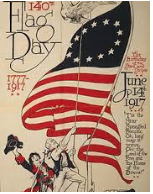 Today is flag day and the Pennsylvania State Courts are closed. This holiday commemorates the day when the Continental Congress adopted the stars and stripes in 1777. Half-way between Memorial Day and Independence Day, its a national holiday that has never caught on.
Although state courts are closed, relatively few other government offices are. Federal Courts are open. The Post Office is delivering the mail. My municipality is open for business today. The clerk I asked about it seemed puzzled by the idea that June 14 was a holiday. Our School District doesn’t mention Flag Day on its calendar. Neither does the the City of Pittsburgh school calendar, which lists today as a snow make-up day.
If you asked ten ten people when Flag Day occurs, it is my guess that you may not find anyone who knows. And why should they?
Yes, there are parades, a few of them. The National Constitutional Center seems to have the biggest Flag Day celebration in the Country this year. Otherwise, there is very sparse mention in the media. Nothing appears on page 1 of the Pittsburgh Post-Gazette, not even a list of the few government offices that are closed. On page two, at the bottom, there is a short mention in the Almanac, which lists historical events that occurred on the date of publication.
Happy Flag Day!
CLT
Peace and Serenity at the Courthouse Door
Posted by Cliff Tuttle| June 13, 2018 | © 2026
No. 1,502
Just in case you never noticed, the courtyard of the Family Division Courthouse is a pleasant oasis in the middle of downtown Pittsburgh. An inviting place to eat your lunch and watch the squirrels and decompress.
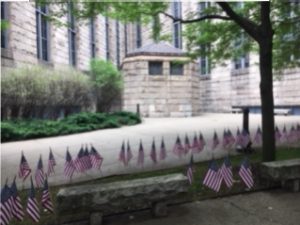
The exercise yard of the old jailhouse, built in 1900, has never looked better.
You cannot see the city traffic all around you, behind the walls.
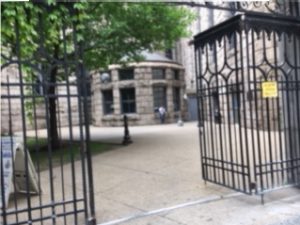
Welcome to the Family Division. Juvenile Court is on your right.
Famous Last Words: You Who Enter Here Abandon Hope.
Posted by Cliff Tuttle| June 12, 2018 | © 2026
No. 1,501
An automated external defibrillator (AED) is a portable device that checks the heart rhythm and can send an electric shock to the heart to try to restore a normal rhythm. AEDs are used to treat sudden cardiac arrest (SCA). SCA is a condition in which the heart suddenly and unexpectedly stops beating.
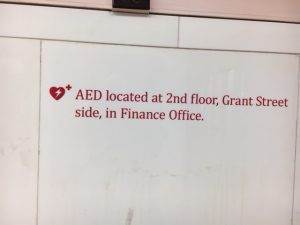
There used to be one on the second floor of the City County Building on the Ross Street side. Its gone now, moved to the far side of the building on the second floor. If you go there, perhaps because you remember the device being there, this sign on the wall tells you where it has been moved.
Unfortunately, you can’t get from one end of the second floor to the other directly. You must take the elevator to the lobby, walk the length of the building (a city block) ride up the elevator to the second floor and find the Finance Office. This walk, even at a slow pace, would probably kill somebody suffering an SCA.
Why isn’t this AED located in the lobby? Has anybody ever needed to use it at either location?
CLT
Casa San Jose Rapid Response Team Helps to Enable those Arrested by ICE to Obtain Due Process.
Posted by Cliff Tuttle| June 9, 2018 | © 2026
 No. 1,500
In celebration of reaching Post No. 1,500, Pittsburgh Legal Back Talk has published an interview with Jarrod West of Casa San Jose about the lawyers’ volunteer program organized by Casa San Jose to assist persons arrested by the U.S. Immigration and Customs Enforcement — ICE — in gaining due process.
Casa San Jose is a community resource center that advocates for and empowers Latinos by promoting integration and self-sufficiency. The Sisters of St. Joseph of Baden opened Casa San José (House of St. Joseph) in 2013. It serves as a base of support for English language learners, helping them to access services–especially services for children, youth, and families–in order to better acclimate to their new home in the Pittsburgh area and to know the experience of welcome here. Casa has a staff of six, with over 65 active volunteers (I am one of those volunteers).
The Casa San Jose Community Center is located at 2116 Broadway Avenue in Beechview. Telephone: 412-343-3111.
This Center was opened to support the ongoing and important work of Sister Janice Vanderneck, who has worked with the Latino community in the Pittsburgh region for many years. She has devoted herself to helping Latinos navigate the health system, social services, and the legal system to survive and to thrive in this community. More than 1,000 Latinos have benefited from her support over the years. Her vision has been to create a real community center for Latinos and to deliver the services that are needed as the growing Pittsburgh economy attracts more and more Latinos to southwestern Pennsylvania. Her countless hours of support and commitment over many years has culminated with the founding of Casa San José as the trustworthy, go-to source of support to help underserved Latino immigrants access the assistance and services they need.
 Among its many activities, Casa San Jose has organized a group of volunteer attorneys called the Rapid Response team. I asked Jarrod West, a San Jose activity organizer who schedules the Rapid Resource team to explain what it is all about.
–informs ICE staff that the attorney represents the detainee;
–requests the reason for detention; the “A” (alien) Number; the place where the detainee is to be transferred; whether bond will be set and the bond amount.
— After this information is obtained, the volunteer lawyer submits a letter withdrawing legal representation to ICE so an immigration attorney can enter an appearance if desired.
A lot of reasons. I’ve always tried to volunteer in some capacity, whether teaching ESL or planting trees. But the thing that really drew me to CSJ was anger: anger at our ongoing (and seemingly worsening) treatment of people who only want to provide for themselves and their families. I needed to find a more useful way to push back than just being angry every time I read the news or heard about this happening in my community.
Q: What might be some meaningful experiences you have had while working with Casa San Jose?
Tags: 1 > 500th post > Best > ICE > Jarrod West > Pittsburgh Latino community > Rapid Response team > Sister Janice Vanderneck > U.S. Immigration and Customs Enforcement
Thinking Inside the Box
Posted by Cliff Tuttle| May 29, 2018 | © 2026
No. 1,499

Image: Ideapod
Thought for the day. We all live in a fragile physical envelope that is custom made for our survival. But just outside, the conditions are hostile to our continued existence. We would all die in an instant.
Just saying.
CLT
A Familiar Story
Posted by Cliff Tuttle| May 28, 2018 | © 2026
No. 1,498
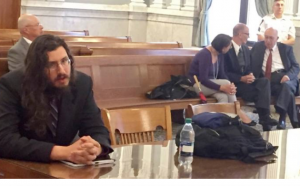
Image: abc.ca
Here’s a story that I hear fairly often. It takes place in Syracuse New York, but it could be happening anywhere. A relative or significant other who is living free without cost refuses to leave. This one is a thirty-something son who doesn’t have a job. The judge is prepared to sign an eviction order and he’s threatening to appeal.
There are two ways to do it. One is to begin an action for possession with a Magistrate. The other is to commence an action in ejectment, which goes before a judge.
CLT
The Blue Danube and 2001 as Seen from 1968.
Posted by Cliff Tuttle| May 28, 2018 | © 2026
No. 1,497
Gratitude on Memorial Day
Posted by Cliff Tuttle| May 27, 2018 | © 2026
No. 1,496

Image: time.com
Gratitude is an empowering emotion. It overcomes selfishness and petty quarrels. It makes us better and stronger.
Whether or not we realize it, gratitude can be paired with other emotions like sadness or joy. So many of those emotions are reflexive, responses to the events of our lives. But we don’t have wait for a feeling of gratitude to come in response to an outside stimulus. We can choose to be grateful anywhere, anytime and even when terrible things are happening. In tragic times, people often step forward to help. They can be strangers or friends we never properly appreciated. Be grateful for that.
And when we focus on feeling grateful for the good things we have been given, we sweep away base feelings like anger, hatred and jealousy.
Memorial Day is about gratitude. But those who died in battle are not the only ones who have earned our heartfelt thanks. To all of you who have made our world a better place, thank you for your service.
CLT
Federal “Protecting Tenants at Foreclosure Act” is Back
Posted by Cliff Tuttle| May 26, 2018 | © 2026
No. 1,495

Image: philalegal.org
The 2010 Dodd Frank Act included a provision that required foreclosing lenders to give notice to tenants of the foreclosed owners. Enacted in 2010, the sunset of this provision was December 31, 2014.
However, this law has been reenacted in SB 2155, the Economic Growth, Regulatory Relief and Consumer Protection Act, which was signed by the President earlier this week. The law requires a ninety-day notification to vacate by the new owner to the hold-over tenant under a bonfire lease. Loan servicing industry publication D S News , which has followed the progress of SB2155, seemed surprised to discover that this re-enactment had occurred. From the lender’s point of view, this lengthens the time required to obtain possession of the collateral. From the tenant’s point of view, until the sheriff’s hammer falls, the lease term may not have ended and it may not be safe to simply leave.
These provisions are contained in Title III, Section 304 of the Act and are effective 30 days after enactment. The reenacted provision applies not only to the foreclosing lender, but also to the purchaser at the sheriff sale, stating:
“after the date of enactment of this title, any immediate successor in interest in such property pursuant to the foreclosure shall assume such interest subject to—
(1) the provision, by such successor in interest of a notice to vacate to any bona fide tenant at least 90 days before the effective date of such notice; and
(2) the rights of any bona fide tenant, as of the date of such notice of foreclosure—
(A) under any bona fide lease entered into before the notice of foreclosure to occupy the premises until the end of the remaining term of the lease, except that a successor in interest may terminate a lease effective on the date of sale of the unit to a purchaser who will occupy the unit as a primary residence, subject to the receipt by the tenant of the 90 day notice under paragraph (1); or
(B) without a lease or with a lease terminable at will under State law, subject to the receipt by the tenant of the 90 day notice under subsection (1),
except that nothing under this section shall affect the require- ments for termination of any Federal or State-subsidized tenancy or of any State or local law that provides longer time periods or other additional protections for tenants.
(b) BONA FIDE LEASE OR TENANCY.—For purposes of this section, a lease or tenancy shall be considered bona fide only if— (1) the mortgagor or the child, spouse, or parent of the mortgagor under the contract is not the tenant;
(2) the lease or tenancy was the result of an arms-length transaction; and
(3) the lease or tenancy requires the receipt of rent that is not substantially less than fair market rent for the property or the unit’s rent is reduced or subsidized due to a Federal, State, or local subsidy.
(c) DEFINITION.—For purposes of this section, the term ”federally-related mortgage loan” has the same meaning as in section 3 of the Real Estate Settlement Procedures Act of 1974 (12 U.S.C. 2602).”
The reenacted statute also contains special protection for Section 8 Tenants. unless the successor in ownership intends to occupy the premises, the property shall pass subject to the existing lease and reimbursement contract. The prospective owner-occupier must give the same 90 days’ notice.
CLT
Tags: bona fide lease or tenancy > Dodd Frank > Economic Growth > foreclosure > ninety-day notification to vacate > Regulatory Relief and Consumer Protection Act > SB 2155 > Section 304 > Title III
Welcome
CLIFF TUTTLE has been a Pennsylvania lawyer for over 45 years and (inter alia) is a real estate litigator and legal writer. The posts in this blog are intended to provide general information about legal topics of interest to lawyers and consumers with a Pittsburgh and Western Pennsylvania focus. However, this information does not constitute legal advice and there is no lawyer-client relationship created when you read this blog. You are encouraged to leave comments but be aware that posted comments can be read by others. If you wish to contact me in privacy, please use the Contact Form located immediately below this message. I will reply promptly and in strict confidence.
Recent Posts
- Sheriff Sales in the COVID-19 Era
- MORTGAGE FORECLOSURE: Cares Act creates gigantic opportunity for borrows under federally-backed and owned mortgages.
- PA Appellate Courts Schedule Arguments Using Electronic Media
- US Supreme Court holds that juries must render unanimous decisions in state criminal cases
- Signs of the Times — the future shortage of dentists.