Proud Member of the Rapid Response Team for:

Click Here To Learn More About How You Can Help
Or
Call 412-378-8779
Categories
- 2012
- 2013
- 2016
- 2017
- 2018
- Advertising
- Advocacy
- Amazing!
- Appellate Practice
- Apps for Lawyers and Others
- AVVO Answers
- Bankruptcy
- Blawging
- Business
- Casa San Jose
- Case Update
- Christmas!
- Civil Litigation
- Civil Rights
- Civility and Courtesy in the Practice of Law.
- Congressional Redistricting
- Constitutional Law
- Construction Law
- Consumer Protection
- Contract Law
- Coronavirus
- Courthouse Scenes
- COVID-19
- Credit Card Collection Litigation
- Criminal Law
- Cyber security
- Decision making
- Employment Law
- Encore Post
- Environmental Law
- Estates and Trusts
- Ethics
- Evidence
- Fair Housing
- Fake News
- Family Law
- Fifty Years Ago
- fracking
- Future of the Law
- Great Lawyers
- History
- Holidays
- How to . . .
- Humor and Satire
- Immigration
- insurance
- Jack Sez
- Landlord and Tenant law and litigation
- Lawyering
- Legal Education
- Legal Ethics
- Legal History
- Legal Marketing
- Legal Technology
- Legal Writing
- Life Affirmation
- Life on the Internet
- Links
- Milestones
- Mortgage Foreclosure
- News Commentary
- Oil and Gas
- On line chicanery
- On-line Security
- One Hundred Years Ago
- Oriegate
- Orphan's Court Practice
- Personal Privacy
- Personal Productivity
- Phishing
- Pittsburgh
- Pittsburgh Legal Back Talk
- Pittsburgh Legal Community
- Pokemon Litigation
- Politics and Government
- Post September 11
- Practice of Law
- Privacy
- Property Assessments
- Real Estate
- Real Estate Contracts
- Reassessment 2012
- Retweets
- Right to Reputation
- SCOTUS
- Screenshots!
- Security and Privacy
- Senior Lawyers
- Seven Foundations of Time Mastery for Attorneys
- Signs of the Times
- Solo by Choice: The Review
- Tell Us Something . . .
- Ten Years of Pittsburgh Legal Back Talk
- Tenth Anniversary
- Tenth Anniversary Year of PLBT
- The continuing American Revolution
- the Review
- trademark and service mark
- Trends in the Law
- UTPCPL
- Vocabulary Word of the Day
- Weekend Book Review
- Winners and Losers
- Words Lawyers Use
- Workers Compensation
- Zoning
Bad decision: Engineer leaves voicemail about cracks in the bridge.
Posted by Cliff Tuttle| March 18, 2018 | © 2026
No. 1,444
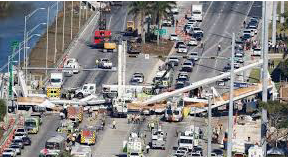
Image: theepochtimes.com
According to this article in the Miami Herald, the fact that cracks started to appear in the Florida International University Foot Bridge (which collapsed when it had been used for only a few days) was not necessarily bad news. Maybe so, but that won’t sound very convincing to the jury, will it?
I wish only to point out the obvious. Don’t ever leave just a voicemail about something that is potentially as dangerous as cracks appearing in a new bridge. By its nature, a voicemail is left when you don’t reach the other party. Which means, you don’t know when, if ever, the voicemail is heard or whether the right person heard it. You also don’t know whether the recipient took it seriously enough to act on it immediately. The bridge may collapse before anyone even listens to the message.
At the bare minimum, make sure you actually communicate with the person who is responsible for making the decision what to do. Make sure your communication is clear and understood. And make a record of it. A follow up email is essential.
CLT
Moon over the Ocean.
Posted by Cliff Tuttle| March 18, 2018 | © 2026
No. 1,443

“When we know the mind of God. I say we will understand the Universe completely.” — Stephen Hawking
Even Once-in-a-Century Events Eventually Happen.
Posted by Cliff Tuttle| March 18, 2018 | © 2026
No. 1,442
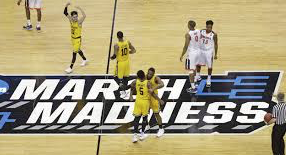
Image: staradvertiser.com
Nobody knows what the real odds were that the University of Maryland Baltimore City, a lowly 16th seed in the NCAA basketball tournament, would defeat the number one seed Virginia Cavaliers. The last-place teams are deliberately selected to give small schools who can’t compete for top recruits a piece of the tournament action. Once thrust into the arena, they usually go down quietly. Usually. But based upon the fact that a bottom-ranked team finally defeated a top-ranked team once after 138 tournaments, its a fair guess that the odds of the underdog emerging triumphant are about 100 to 1.
People think that events with long probabilities will never happen. Not so. Maybe not today. But never? If you stick around long enough, even the rarest outcome will eventually occur. And of course, the odds may have been miscalculated all along or may change. That’s why there have been at least three 500-year storms in Western Pennsylvania in the past few decades.
There’s often a sleeper out there, too. The presence of Napoleon on the battlefield, it was said, was worth 40,000 men. Eventually, the opposing armies refused to engage when he was known to be in the field. They would turn around and seek out a Napoleonic army to fight that was commanded by one of his less gifted subordinates.
Getting back to basketball, everybody knows that teams get hot and teams get cold. Luck intervenes. Miscalculations occur. Time runs out. That’s what makes basketball exciting to watch.
The same factors apply to litigation. Just as in sports, David can and sometimes does bring down Goliath. Lawyers get hot. Lawyers get cold. Witnesses perform better than expected on one occasion and disastrously on the next. You draw the wrong judge. The jury doesn’t get it.
But unlike in sports, litigation doesn’t have to be a fight to the bitter end. People with disputes can settle. It makes supreme sense to do so in many cases. You can dispose of all that risk and replace it with a relative certainty. Even the overwhelming favorite in a fight to the finish may gain unforeseen benefits. For example, a payment plan with teeth may be worth much more than than a large uncollectible judgment.
It takes work to settle a case. It often takes imagination, timing and persistence. The lawyer must have the vision to see the benefits of compromise when his or her client does not.
Basketball tournaments are great entertainment, but litigation is reality. Don’t get caught in a 500-year storm.
CLT
On having a bad day.
Posted by Cliff Tuttle| March 15, 2018 | © 2026
No. 1,441
 Today we commemorate the 2,067th anniversary of when Julius Caesar had a very bad day.
We all have them. Lawyers, who engage in a very competitive environment, perhaps have more than their share.
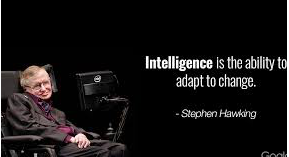
Yesterday, one of the greatest minds of our time passed into eternity. In one sense, he had been having a world’s record string of bad days for a very long time. Lou Gehrig’s Disease deprived him of everything, but not quite. In the end, he had control of one facial muscle and that was enough to enable him to operate a computer that empowered him to speak and write books. He expanded our mental universe forever with extraordinary ideas about time-space, black holes, the event horizon and so much more.
His spirit was unconquered. Don’t look down at your feet, he said, look up at the stars.
The next time you have a bad day, remember the great Stephen Hawking. Then think to yourself:
“What’s your excuse?”
CLT
Rites of Spring: Daylight Savings Time and banishing Winter.
Posted by Cliff Tuttle| March 10, 2018 | © 2026
No. 1,440
 Although the pond may still be frozen solid, Daylight Savings promises it won’t stay that way too long.
We live in the Age of Reason, a time when we no longer believe in superstitious practices. But we follow plenty of them anyway because they are still part of us. Sometimes we ignore the illogic. Sometimes we laugh at ourselves. But we do what we do because it makes us feel better.
And so, when Daylight Savings Time arrives we drive Winter away by the ritual of turning the clocks forward. As we move further into the electronic age, we have fewer and fewer clocks that require any effort to reset. But that hardly matters. We still go through the symbolic process of putting an hour into an imaginary savings account, to be withdrawn and spent when the darkness of Winter returns.
Yes, there are always curmudgeons who complain about losing sleep. And of course there is a simple solution to that — go to bed early, take a nap, take two naps.
Early this morning, the sidewalks were filled with walkers, runners, dog-walkers — all bundled up because it is still rather cold. But the pending onset of Daylight Savings seems to have triggered the primeval force within the subconscious mind that propels us into celebrating the change of Seasons.
After all, I hear we are descended from species who survived Winter by hibernation. How much of those instincts are still buried deep inside the ancient regions of the brain?
Enough of that! Its time to awake!
CLT
Is a new Act 6 or Act 91 Notice required when a second mortgage foreclosure is commenced?
Posted by Cliff Tuttle| March 10, 2018 | © 2026
No. 1,439
 This issue was addressed in Wells Fargo Bank v. Spivak, 104 A.3d, 7 (2014) where there had been a voluntary discontinuance followed by the filing of a new case, without re-sending of the Act 6 Notice.
The Superior Court apparently distinguished the facts in Spivak in a non-precidential decision in J. C. Morgan Chase Bank v. Taggart, 470 EDA (2016).
The Taggart Court affirmed the lower court’s decision that the lender did not have to issue a new Act 6/91 notice when the first complaint had been dismissed due to a failure of the Plaintiff to respond to preliminary objections, followed by a re-filing. As a non-precidential decision by the same Court, Taggert could not overrule Spivak, nor could it establish precedent for the holding that Plaintiff need not give a new Act 6/91 notice after an involuntary dismissal.
The Supreme Court has recently granted allocatur in Taggert on February 22, 2018, to address the following issue:
“Whether a lender/mortgagee whose first complaint in mortgage foreclosure against a borrower/mortgagor was dismissed is required to send a new Notice of Intention to Foreclose pursuant to 41 P.S. § 403(a) (Act 6 Notice) prior to filing a second complaint in mortgage foreclosure.”
Case No. 428 EAL
Although Spivak was never reviewed, the Supreme Court is now likely to address the holdings in both Taggert and Spivak, since they are opposite sides of the same coin.
There is an interesting discussion of the two cases in D S News, an on-line newsletter for the mortgage servicing industry. This included some sage advice from Bradley J.Osborne of Richard Squire & Associates, a firm that represents lenders in mortgage foreclosures state-wide. Osborne suggests that lenders send the Act 6/91 Notice, thus avoiding potential litigation that could last for years.
Brings to mind one of my favorite sayings, attributed to the Roman Emperor Augustus: “Make Haste Slowly.”
CLT
Tags: Act 6 of 1984 > Act 91 of 1983 > allocatur > Pennsylvania Supreme Court
Question: How much does this job pay?
Posted by Cliff Tuttle| March 10, 2018 | © 2026
No. 1,438

This ad appeared in the Pittsburgh Post-Gazette. Of course, it raises a number of other questions.
Carolina Beats Duke!
Posted by Cliff Tuttle| March 10, 2018 | © 2026
1,437

Promoted Tweets Are Hacking My Twitter Account.
Posted by Cliff Tuttle| March 9, 2018 | © 2026
 No. 1,436
I DID NOT — NOT — AUTHORIZE THIS PROMOTED TWEET TO BE INSERTED INTO MY TWITTER ACCOUNT!
FAMILY LAW: Parental responsibility and the risk of football concussions.
Posted by Cliff Tuttle| March 9, 2018 | © 2026
No. 1,435
The New York Times ran an article recently focusing on a custody dispute involving a divorced Upper St. Clair couple with a family law issue that is becoming increasingly common.
Their son played high school football and had experienced concussion-like symptoms, but had eventually been cleared by a doctor to play. His father, the non-custodial parent, filed suit to prevent his son’s participation. The mother says that the boy knows the risks and is able to make his own decision. As might be anticipated, the boy wants to play and does not wish to have contact with his father.
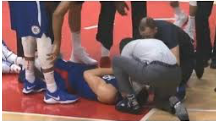
Image: You Tube
According to domestic lawyer Joe Cordell, quoted in the Times article, about one-third of the lawyers at Cordell & Cordell, practicing in 40 states, have encountered disputes regarding concussion risks in scholastic football. He says that they are particularly prevalent in “football states”, which include Pennsylvania.
In the Upper St. Clair case profiled in the Times,the father says that since the boy had already experienced concussion symptoms, which in the view of the father increases the risk of CTE developing, it is irresponsible for a parent to expose his child to such a risk. However, the judge has not been willing to sign an order prohibiting the son from playing. At least not yet.
This problem is not going away and it is not too hard to imagine the day when the law will begin siding with the parent who wants to withhold permission for this activity. Improving helmet technology, changes in the rules, the occurrence of catastrophic injuries, evolving social values and other factors, some yet unforeseen, will contribute to the ultimate outcome.
CLT
« go back — keep looking »
Welcome
CLIFF TUTTLE has been a Pennsylvania lawyer for over 45 years and (inter alia) is a real estate litigator and legal writer. The posts in this blog are intended to provide general information about legal topics of interest to lawyers and consumers with a Pittsburgh and Western Pennsylvania focus. However, this information does not constitute legal advice and there is no lawyer-client relationship created when you read this blog. You are encouraged to leave comments but be aware that posted comments can be read by others. If you wish to contact me in privacy, please use the Contact Form located immediately below this message. I will reply promptly and in strict confidence.
Recent Posts
- Sheriff Sales in the COVID-19 Era
- MORTGAGE FORECLOSURE: Cares Act creates gigantic opportunity for borrows under federally-backed and owned mortgages.
- PA Appellate Courts Schedule Arguments Using Electronic Media
- US Supreme Court holds that juries must render unanimous decisions in state criminal cases
- Signs of the Times — the future shortage of dentists.