Proud Member of the Rapid Response Team for:

Click Here To Learn More About How You Can Help
Or
Call 412-378-8779
Categories
- 2012
- 2013
- 2016
- 2017
- 2018
- Advertising
- Advocacy
- Amazing!
- Appellate Practice
- Apps for Lawyers and Others
- AVVO Answers
- Bankruptcy
- Blawging
- Business
- Casa San Jose
- Case Update
- Christmas!
- Civil Litigation
- Civil Rights
- Civility and Courtesy in the Practice of Law.
- Congressional Redistricting
- Constitutional Law
- Construction Law
- Consumer Protection
- Contract Law
- Coronavirus
- Courthouse Scenes
- COVID-19
- Credit Card Collection Litigation
- Criminal Law
- Cyber security
- Decision making
- Employment Law
- Encore Post
- Environmental Law
- Estates and Trusts
- Ethics
- Evidence
- Fair Housing
- Fake News
- Family Law
- Fifty Years Ago
- fracking
- Future of the Law
- Great Lawyers
- History
- Holidays
- How to . . .
- Humor and Satire
- Immigration
- insurance
- Jack Sez
- Landlord and Tenant law and litigation
- Lawyering
- Legal Education
- Legal Ethics
- Legal History
- Legal Marketing
- Legal Technology
- Legal Writing
- Life Affirmation
- Life on the Internet
- Links
- Milestones
- Mortgage Foreclosure
- News Commentary
- Oil and Gas
- On line chicanery
- On-line Security
- One Hundred Years Ago
- Oriegate
- Orphan's Court Practice
- Personal Privacy
- Personal Productivity
- Phishing
- Pittsburgh
- Pittsburgh Legal Back Talk
- Pittsburgh Legal Community
- Pokemon Litigation
- Politics and Government
- Post September 11
- Practice of Law
- Privacy
- Property Assessments
- Real Estate
- Real Estate Contracts
- Reassessment 2012
- Retweets
- Right to Reputation
- SCOTUS
- Screenshots!
- Security and Privacy
- Senior Lawyers
- Seven Foundations of Time Mastery for Attorneys
- Signs of the Times
- Solo by Choice: The Review
- Tell Us Something . . .
- Ten Years of Pittsburgh Legal Back Talk
- Tenth Anniversary
- Tenth Anniversary Year of PLBT
- The continuing American Revolution
- the Review
- trademark and service mark
- Trends in the Law
- UTPCPL
- Vocabulary Word of the Day
- Weekend Book Review
- Winners and Losers
- Words Lawyers Use
- Workers Compensation
- Zoning
The Executor or Administrator of the Estate of a residential tenant may terminate the lease early.
Posted by Cliff Tuttle| January 24, 2018 | © 2026
No. 1,404

Image: nepamcgraw.com
The Landlord and Tenant Act was amended in 2011 to give the executor or administrator of a deceased tenant who was the sole resident of a residential unit the right to terminate the lease upon 14 days’ written notice to the landlord. The termination will be effective on the last day of the month after death or upon surrender of the rental unit and removal of all of the decedent’s property, whichever comes last.
This provision was intended to eliminate the so-called “death penalty” whereby the estate may have been required to pay the balance of the rent for the term of the lease.
Here is copy of the amending statute, House Bill 1526 of 2011.
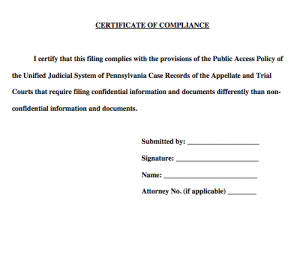
Be sure to attach Certificates of Compliance to your pleadings.
Posted by Cliff Tuttle| January 23, 2018 | © 2026
No. 1,403
 Section 7.0 of the “Public Access Policy of the Unified Judicial System of Pennsylvania: Case Records of the Appellate and Trial Courts” places the burden of screening documents on litigants and attorneys who file them and to exclude or redact certain confidential information (except when using a special Confidential Information Form). The clerks who maintain the records are not required to redact sensitive information, but their hands will not be slapped if they do. Information prohibited includes:
- Social Security Numbers;
- Financial Account Numbers, except an active financial account number may be identified by the last four digits when the financial account is the subject of the case and cannot otherwise be identified;
- Driver License Numbers;
- State Identification (SID) Numbers;
- Minors’ names and dates of birth except when a minor is chargedas a defendant in a criminal matter (see 42 Pa.C.S. § 6355); and
- Abuse victim’s address and other contact information, including employer’s name, address and work schedule, in family court actions as defined by Pa.R.C.P. No. 1931(a), except for victim’s name.
If you haven’t filed anything in the Department of Court Records lately, you might be told that you can’t until you sign and attach the document shown below. If you forget to attach one, they will probably hand you a copy of this certificate to sign.
But don’t ask anybody there to explain it. Just do it.
Tags: Certificate of Compliance > Public Access Policy
Supreme Court moves quickly on Congressional Redistricting. So, what happens when the Legislature and Governor almost certainly do not meet the deadline?
Posted by Cliff Tuttle| January 22, 2018 | © 2026
No. 1,402

Image: fairvote.org
The Supreme Court didn’t waste any time finding the current Congressional redistricting plan unconstitutional and ordering redistricting in the case of League of Women Voters v. Commonwealth, No. 155 MM 2017. See our December 30 and January 16 posts on the case. Considering the burden it places upon the conduct of the 2018 primary election, has the Court traveled too far and too fast?
In addition to reviewing the findings and conclusions of law submitted by Commonwealth Court Judge Brobson, it heard oral arguments by parties, intervenors and amici curiae last Wednesday, January 17, 2018. Then, with incredible celerity, considering the complexity and importance of the issues presented, the Court issued a per curium order, followed by one concurring and dissenting statement and two dissenting statements. Links to these documents can be found at the bottom of this post. Opinions, explaining why the Court says the redistricting plan is unconstitutional (or not), will come later.
The majority struck down the Congressional Redistricting Act of 2011, relying upon the Pennsylvania Constitution alone, enjoining the use of the existing districts in the upcoming primary election. Only the special election to fill the remaining term of Tim Murphy in the 18th Congressional District is exempt.
“First, the Court finds as a matter of law that the Congressional Redistricting Act of 2011 clearly, plainly and palpably violates the Constitution of the Commonwealth of Pennsylvania, and, on that sole basis, we hereby strike it as unconstitutional. Accordingly, its further use in elections for Pennsylvania seats in the United States House of Representatives, commencing with the upcoming May 15, 2018 primary, is hereby enjoined.”
It seems pretty clear that our Supreme Court does not wish to permit the losing party, namely the Republicans, to scuttle the high speed implementation of this Court’s order by appealing to the United States Supreme Court.
Nevertheless, the Petition for Certiorari is probably in preparation at this moment. So we’ll have to see how it fares. While the Pennsylvania Supreme Court has final jurisdiction on questions arising under the State Constitution, it isn’t inconceivable that US Supreme Court will pick it up because, by its nature, it involves federal questions currently before it.
The General Assembly is granted the right to submit a plan which satisfies the Constitutional requirements, but they must put it together by February 9 and get the approval of the Governor by February 15.
If not physically impossible, such a schedule is surely politically impossible. Throwing two incumbents together or creating a district with no incumbents is unacceptable to politicians. The criteria set forth by the Court, set forth below, makes that very hard to do. Don’t count on a plan being submitted at all and on the long shot odds that this actually happens, don’t count on the Supreme Court to find the plan acceptable.
So, when the legislative plan is either not submitted or rejected by the court, the parties, including intervenors, will have a crack at submitting plan on February 15. In other words, they should have it in the ready for submission on or before the February 15 deadline.
Although there are no opinions yet published to explain the Court’s reasoning, criteria are announced and fulfilling them will require immense amount of work, even in the age of computers.
[In order] “to comply with this Order, any congressional districting plan shall consist of: congressional districts composed of compact and contiguous territory; as nearly equal in population as practicable; and which do not divide any county, city, incorporated town, borough, township, or ward, except where necessary to ensure equality of population.”
The final redistricting plan, as fashioned by the Court, is to be available by February 19 and the Executive Branch Respondents are expected to take measures, including adjusting the election calendar if necessary, to implement it for the May 15 primary.
I’ll bet you a month of lunches that this ambitious plan will not be carried out!
Click here for a copy of the Order.
Click here for Justice Baer’s concurring and dissenting statement.
Click here for Chief Justice Saylor’s dissenting statement.
Click here for Justice Mundy’s dissenting statement.
CLT
Tags: congressional redistricting > Supreme Court of Pennsylvania
Calling all Concierges!
Posted by Cliff Tuttle| January 21, 2018 | © 2026
No. 1,401

This classified ad appeared in the Pittsburgh Post Gazette on January 21, 2018.
We all know what a concierge used to be. It was the person at a desk by the door of a hotel who not only recommended a restaurant, but made your reservations. The concierge often could straighten out your airline tickets or any number of problems that travelers encounter but don’t have the time, expertise and influence to fix. Pretty useful. No wonder the word has such a positive ring to it.
So much so, that unrelated businesses started to call their help desk a concierge. If you bought your health insurance from UPMC, you had access to their concierge service that would pilot you through the mysteries of things medical. Others have pushed the concept further. There are private medical practices that bill themselves as concierge and offer paid-up-front memberships. Epic Medical, for example, states in its website that “Concierge medicine individualizes private health care to your lifestyle and needs, supporting your quality of life.” It touts “any-time office hours, preferred appointments, 24/7 physician access, nutrition/wellness counseling, house calls ..” Yipes! House calls!
Not to be outdone by anybody, the American Express Platinum Card touts a “complimentary concierge” for members. And all this has led to personal concierge services and even hyper-personal concierge service for the wealthy. And senior concierge services, too. They drive them to the doctors, do shopping or whatever is needed.
It is starting to sound like we are becoming a nation of servants.
And yes, there are concierge lawyers. Or at least there are law firms who advertise a concierge practice. Holborn Law, a California firm, says that it maintains both a traditional practice and a concierge law practice. In a blog post entitled “Concierge Lawyer: The Future of Law?”, it describes the concierge law practice thusly:
“One aspect of concierge lawyering involves better access to your lawyer. For many concierge lawyers, clients have the choice of meeting at the lawyer’s location, having an attorney come to their home or business, or conducting a video consultation. With lawyers available on weekends and after usual business hours, clients no longer have to miss work to meet with an attorney.”
It touts, among the benefits, access during off-hours, avoiding traffic and down town parking. “With a concierge lawyer, clients may be able to sign a one time retainer that makes their lawyer just a quick phone call away. Not only can this approach save time and money, but it can easily result in a more positive client experience.”
What hasn’t been quite spelled out here is that concierge clients often pay an annual or quarterly retainer for the privilege of off-hour phone consultations. Larry Boudine, a legal marketing maven, spells it out in his “Lawmarketing Blog.”
“The clients love it, because they frequently need input on a decision they’re about to make, but just want to run it by the firm lawyer first. They are less interested in getting a long opinion letter or extensive policy written. They just want a quick answer.
The lawyer loves it too. She gets paid a quarterly retainer — revenue she can count on — and the calls act as a feeder for her litigation practice for which she charges by the hour. She has set up concierge services for fast-food chains, which have lots of employee issues.”
Some law firms call themselves a concierge practice because they make house calls. Here’s a divorce lawyer who calls himself a concierge in Florida.
At this point, many lawyers who are reading this will be saying to themselves, “I do all this, but I don’t charge an annual retainer.” And that would be a fair assessment. Lawyers have been concierges for thousands of years. The use of the designation “concierge law practice” is redundant.
CLT
Post No. 1,400
Posted by Cliff Tuttle| January 20, 2018 | © 2026

Image: woodendcfa.org
No. 1,400
AND NOW, this 20th day of January, 2018, a cold dreary day in January, I am tapping out my 1,400th post in this blog. I imagine that I am the only person in the world who has actually read every one of them.
It doesn’t seem too long ago, March 5, 2014, that I wrote Post No. 1,000, an interview with Professor Al Pelaez who taught contracts to at least half of the lawyers in Pittsburgh.
On August 24, 2010, we celebrated Post No. 500 by conducting a Twitterview with Lance Godard, who ran the very successful legal blog (alas, no longer with us) 22 Tweets.
On March 1, 2010, I wrote Post No. 400. In it, I declared that I wrote blog posts because it made me happy. “If you won’t allow yourself to be happy until you reach some goal, you will never be happy — ever.”
Before that, I didn’t keep track of the post numbers. Since the first post was on July 7, 2008, it took almost 2 years to get to 400, but only another 6 months to make it to 500. Then, it took 4 more to make it to 1,000. And then another 4 to hit 1,400.
So what should I do to celebrate 1,500? I hope to do so by the time this blog has a tenth anniversary in July. As a ten-year old blog, Pittsburgh Legal Back Talk should have enough cred to do interviews of anybody in this town. So, maybe we should do a six-month long series of interviews. Why not?
CLT
Here’s something to make you smile on a dreary January day.
Posted by Cliff Tuttle| January 20, 2018 | © 2026
No. 1,399

Image: Atlas obscura
The Institute of Cytology and Genetics at Novobirsk State University honors the humble lab mouse.
Feeling frustrated? Work it off with a little axe throwing.
Posted by Cliff Tuttle| January 16, 2018 | © 2026
No. 1,398

Image: adrenalinquarry.co.uk
There are a multiplicity of reasons. Steelers, Pirates, snow, arctic temperatures. There are a multiplicity of reasons to work off all that aggression you feel. So why not go down to Millvale and throw a few axes. Here’s where. You may not wish to take your spouse or boss along, though.
CLT
Congressional redistricting is on the docket in 2018.
Posted by Cliff Tuttle| January 16, 2018 | © 2026
No. 1,397
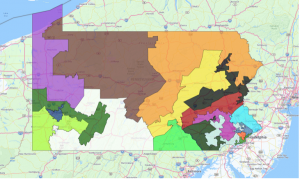
The Pennsylvania Supreme Court has announced that it will promptly take up League of Women Voters v. Commonwealth, which is the case involving the re-drawing of the map of Congressional Districts.
See our December 30, 2017 post on the subject.
A decision is expected in February. Speed is of the essence here, since the United States Supreme Court is poised to decide similar Constitutional issues involving how far the legislature can go in district realignment to maximize the voting power of one party and minimize the power of the other.
The U.S. Supreme Court has already heard arguments in a case from Wisconsin and will soon hear one from Maryland. Two cases from Texas have been recently added.
The argument attacking the district alignment can be stated in terms of votes wasted. By concentrating a high proportion of opposition voters in certain districts, under that theory, the votes beyond those required to win a majority are wasted because they cannot be cast in a neighboring district where the outcome could be changed. The problem is how to define this practice in a way that can be addressed by judicial action. Either party can be expected to attempt to gain such an advantage. When does the reassignment of voters to change the outcome become so extreme that it violates the Constitution by denying equal protection to voters in the minority? And what does a court do to protect the rights of the aggrieved party? Proponents of judicial intervention have presented statistics prepared by expert witnesses, but judges are often skeptical. Chief Justice Roberts expressed that view during oral argument in the Wisconsin case.
CLT
Getting Over It.
Posted by Cliff Tuttle| January 15, 2018 | © 2026
No. 1,396

Image: Scout.com
Its great to live in a city with competitive sports teams. It builds a sense of community. It breeds optimism. There is something exciting to look forward to in an otherwise nondescript week.
But don’t lose sight of the fact that we are only spectators. There is nothing we personally can do to change the outcome of this past weekend’s game or any other sports event. Moreover, there is almost no benefit to fretting or arguing about what could have been done by somebody else. If you must, debate it for one day maximum and then give it up.
Don’t go around in a funk, spending a lot of time brooding and otherwise distracting ourselves from important things that we are required to do and we can change. Stop listening to sports radio and TV call-in shows for a while. And walk away from those negative people in your life who refuse to let it go. Focus on today.
Thank you Steelers for an exciting season. Thanks, Antonio, for acrobatic one-hand catches. Thanks, Le Veon for all of those amazing runs. Now its time to move on.
Yes, we’ll see you all again (or so we hope) in a few months and start again. In the meantime, do you think that the Pens have finally turned the corner this season?
CLT
In retrospect, did you really want to go there at all?
Posted by Cliff Tuttle| January 14, 2018 | © 2026
No. 1,395

The Bathtub is full of frigid water. Stay home.
Welcome
CLIFF TUTTLE has been a Pennsylvania lawyer for over 45 years and (inter alia) is a real estate litigator and legal writer. The posts in this blog are intended to provide general information about legal topics of interest to lawyers and consumers with a Pittsburgh and Western Pennsylvania focus. However, this information does not constitute legal advice and there is no lawyer-client relationship created when you read this blog. You are encouraged to leave comments but be aware that posted comments can be read by others. If you wish to contact me in privacy, please use the Contact Form located immediately below this message. I will reply promptly and in strict confidence.
Recent Posts
- Sheriff Sales in the COVID-19 Era
- MORTGAGE FORECLOSURE: Cares Act creates gigantic opportunity for borrows under federally-backed and owned mortgages.
- PA Appellate Courts Schedule Arguments Using Electronic Media
- US Supreme Court holds that juries must render unanimous decisions in state criminal cases
- Signs of the Times — the future shortage of dentists.