Proud Member of the Rapid Response Team for:

Click Here To Learn More About How You Can Help
Or
Call 412-378-8779
Categories
- 2012
- 2013
- 2016
- 2017
- 2018
- Advertising
- Advocacy
- Amazing!
- Appellate Practice
- Apps for Lawyers and Others
- AVVO Answers
- Bankruptcy
- Blawging
- Business
- Casa San Jose
- Case Update
- Christmas!
- Civil Litigation
- Civil Rights
- Civility and Courtesy in the Practice of Law.
- Congressional Redistricting
- Constitutional Law
- Construction Law
- Consumer Protection
- Contract Law
- Coronavirus
- Courthouse Scenes
- COVID-19
- Credit Card Collection Litigation
- Criminal Law
- Cyber security
- Decision making
- Employment Law
- Encore Post
- Environmental Law
- Estates and Trusts
- Ethics
- Evidence
- Fair Housing
- Fake News
- Family Law
- Fifty Years Ago
- fracking
- Future of the Law
- Great Lawyers
- History
- Holidays
- How to . . .
- Humor and Satire
- Immigration
- insurance
- Jack Sez
- Landlord and Tenant law and litigation
- Lawyering
- Legal Education
- Legal Ethics
- Legal History
- Legal Marketing
- Legal Technology
- Legal Writing
- Life Affirmation
- Life on the Internet
- Links
- Milestones
- Mortgage Foreclosure
- News Commentary
- Oil and Gas
- On line chicanery
- On-line Security
- One Hundred Years Ago
- Oriegate
- Orphan's Court Practice
- Personal Privacy
- Personal Productivity
- Phishing
- Pittsburgh
- Pittsburgh Legal Back Talk
- Pittsburgh Legal Community
- Pokemon Litigation
- Politics and Government
- Post September 11
- Practice of Law
- Privacy
- Property Assessments
- Real Estate
- Real Estate Contracts
- Reassessment 2012
- Retweets
- Right to Reputation
- SCOTUS
- Screenshots!
- Security and Privacy
- Senior Lawyers
- Seven Foundations of Time Mastery for Attorneys
- Signs of the Times
- Solo by Choice: The Review
- Tell Us Something . . .
- Ten Years of Pittsburgh Legal Back Talk
- Tenth Anniversary
- Tenth Anniversary Year of PLBT
- The continuing American Revolution
- the Review
- trademark and service mark
- Trends in the Law
- UTPCPL
- Vocabulary Word of the Day
- Weekend Book Review
- Winners and Losers
- Words Lawyers Use
- Workers Compensation
- Zoning
Rules, rules, rules.
Posted by Cliff Tuttle| March 4, 2018 | © 2026
No. 1,434
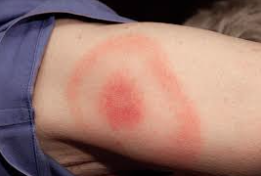
Image: seitechconnect.elsevier.com
I just heard a doctor on the radio who contracted Lymes Disease and after being wheelchair bound and in excruciating pain for a year and a half, effected a cure, partly through experimenting with herbal medicines. He says that we have a Lymes pandemic in semi rural locations in Western Pennsylvania and that we can reduce risk by following certain rules when communing with nature between April and November.
- Don’t wear shorts;
- Wear white shoes, socks, clothes and hat;
- Wear long sleeves;
- Tuck your pants legs into your socks;
- Spray yourself with Deet or some equivalent.
Maybe this is good advice for walking in the woods, but otherwise not very practical. I’ve known a couple of people who contracted Lymes Disease, probably in an environment no wilder than their back yard.
If you are concerned about Lymes Disease, it is probably a good idea to give up gardening, lawn cutting and not own any furry pets.
Then, since the flu is raging at the moment, avoid movie theaters, church, public restaurants, meetings, shaking hands or kissing anyone and carry a supply of those alcohol wipes everywhere you go.
Of course, automobile accidents are a common source of serious injury and death. So it would be a good idea not to drive unnecessarily. Sunny dry days would be best. Avoid dark nights, heavy rain, snow, rush hours and bad intersections. When driving, change lanes as little as possible. Stay out of the left hand lane, too. Don’t eat, use the phone, change the radio station — driving in silence is better yet. Don’t think about anything but what’s ahead on the road, your destination and how you intend to get there. Of course, don’t drink alcohol or have a large meal before you leave, or anytime for that matter. And don’t forget to always get a good night’s sleep.
I could go on. Every one of the above rules, which we have all acknowledged from time to time, will reduce our risk of disease, injury and early death. The problem is, of course, if we observe all of the practices that will make us safe, we automatically circumscribe a lot of other choices. So, I guess I’ll just have to allow a reasonable risk of Lymes Disease, flu, car accidents and other bad things to occur. In making those choices, I promise not to engage in “if only” recriminations after bad things happen.
The truth is, bad things are often not foreseeable or preventable. Once, while walking in back of the Allegheny County Court House on a cold January day, my view was suddenly obstructed, followed by a loud explosion at my feet. Looking down, my feet were covered by a mound of crushed ice. A large ice- cycle had fallen off the building, one step in front of me. If I had taken one more step before it happened, I would probably have been dead or seriously injured.
At the far end of the probability curve are so-called “black swan events.” The philosopher David Hume speculated about the possibility that there might be black swans in the world, even though no one he knew had ever seen one. In fact, it was later discovered that black swans existed in Australia. A black swan was described by writer Nasim Taleb as an event so rare that it is unpredictable. Great historic events, such as the rise of Napoleon, are often described that way. In hindsight, people often claim that such an event could have been predicted with enough information. But I doubt it.
Then, in the same genre, there is “butterfly effect”. The term arises from the idea that a butterfly flapping its wings might, through a chain of unpredictable events, cause a monsoon. A well-known example: for the lack of nail . . . the kingdom was lost. This is to be distinguished from “butterfly events” which involve the release of a large number of butterflies at weddings and the like.
And when its all over, despite all of the precautions we may or may not make, its wonderful to be lucky.
Have a lucky day!
CLT
On the Wings of an Albatross
Posted by Cliff Tuttle| March 3, 2018 | © 2026
No. 1,433
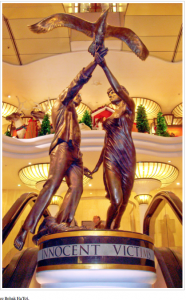
I thought they were extinct, easy prey for rapacious Europeans who colonized much of the World in the 18th and 19th Centuries. Although some breeds of albatross are in danger, they are disbursed over most of the Southern Hemisphere and parts of the Northern Pacific. It appears, from Wikipedia, that most of what I thought I knew about the albatross was wrong.
After being a tourist attraction at Harrods in London, the statue, provocatively entitled “Innocent Victims”, is being taken down. Princess Diana and Dodi Fayed are either being borne away by the great bird or providing it with a momentary landing place.
The bronze statue is being given to Dodi’s father, who commissioned it when he owned Harrods. The balcony above is decorated for Christmas, with a reindeer peaking out.
Hat tip to Althouse on this one. However, I take issue with her statement that the choice of the albatross is iconographically connected to the Holy Spirit. The Albatross, per Coleridge, is a symbol of luck. The albatross meant good luck in life, but woe to the killer of an albatross. Perhaps this albatross is about to carry the star-crossed lovers to a better place.
CLT
Do you know who is listed in the Guinness Book World of Records as the world’s most successful lawyer? Don’t even try to guess.
Posted by Cliff Tuttle| March 1, 2018 | © 2026
No. 1,432
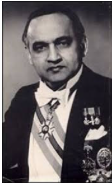 Yes, Guinness really did designate such a lawyer and his name is Lionel Luckhoo. No kidding.
Between 1940 and 1985, Barrister Luckhoo successfully defended 245 homicide cases in a row. A few of them had to be won on appeal. He practiced mostly in his native Guyana and in England.
Think of that. Winning even a modest number of homicide cases is no small achievement. Prosecutors, excellent ones, win that many cases, not defense counsel. What a privilege it would have been to see this master litigator in action.
By contrast, Napoleon personally commanded 60 battles and only lost eight, mostly at the end. Luckhoo won four times that number.
CLT
Tags: Lionel Luckhoo > most successful lawyer in the world
Oh well . . . (sigh).
Posted by Cliff Tuttle| February 28, 2018 | © 2026
No. 1,431

I know you’re out there, Adrian Baron, alias THE Nutmeg Lawyer!
Posted by Cliff Tuttle| February 27, 2018 | © 2026
No. 1,430

I have been getting messages from you on Twitter. So I know you’re out in cyberspace somewhere. Eventually, I even figured out how to find your revived blog. Or is it revised blog? God put me on this Earth in the latter half of the 20th Century in order to teach me that I am not as smart as a twelve year-old after all. Read on.
I tried to write a comment on your first post, but I screwed it up. I don’t do Facebook, mostly because I was afraid I’d never do any work at all. So I screwed up the alternate method. I gave my desk phone number, so you can’t send me any secret codes. But upon revisiting the blog, I discovered a message box. I WILL be more observant. I WILL be more observant.
Sign of The Times: Danger Zone.
Posted by Cliff Tuttle| February 26, 2018 | © 2026
No. 1,429

How long can the Democratic public counter-memorandum remain redacted?
Posted by Cliff Tuttle| February 25, 2018 | © 2026
No. 1,428

The whole point of intelligence/counter-intelligence is obtaining secret information and keeping it secret. In an effort to rebut a prior (unreacted) memo released by Chairman Nunes of the House Intelligence Committee, the minority (pronounced Democrats) released a response which the White House would not approve, for National Security reasons, without serious redaction. The graphic above shows the extent of the editing. If you want to read the memo in its current redacted form, its not hard to find. It made all of the papers.
Yet, it wasn’t too long ago that the word “redaction” was one of those words in the active vocabulary of lawyers and the government wonks only. Thanks to the Russian interference investigations, it has now entered the general parlance. But was it really such a good idea to release such a document at all? Even with redactions?
How long before the fully un-redacted version makes it to the front page of the Washington Post or the New York Times? Such copies exist, of course. Who knows who has them? Russian agents, maybe? Did we already forget how all those emails from the 2016 campaign became public? This is the age of Wikileaks, you know. And before then, the Pentagon Papers. Today, the whole world is porous.
This is a made-to-order opportunity to use one of my favorite Benjamin Franklin quotes. Franklin, as we all know, was dispatched by the Continental Congress to obtain the military and financial support of the King of France for our Revolution. Lots of top-secret stuff passed through his hands. The Brits spied on his activities continuously. In their dispatches to London he was cryptically known as “78.” While Franklin lived long before electronic media, he knew a lot about human nature.
Franklin said: “Three men can keep a secret if two of them are dead.”
The question is not whether the words behind those black panels will be leaked. The question is: “How long?”
Debtor’s Prison, Really?
Posted by Cliff Tuttle| February 24, 2018 | © 2026
No. 1,427
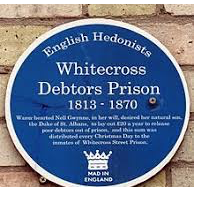
Image: revolve.com
State Senator Guy Reschenthaler, according to today’s Post Gazette, is going to propose legislation to permit people who cannot afford to pay criminal fines or court costs to work them off by performing public service rather than serve jail time.
He refers to the jailing of persons who haven’t paid these amounts as “debtor’s prison.”
Of course, the term “debtor’s prison” has a historical meaning that is quite different from anything we have seen in the United States for a very long time. This involved imprisonment for failure to pay private debt. It was a common practice in England and from there it was brought to Colonial America. The Federal Government abolished the practice of imprisonment pursuant to a civil judgment in 1833, although it persisted in the states.
More recently, the term has been revived to characterize the jailing of individuals when they are unable to pay fines in criminal proceedings. It has also been raised in contempt proceedings when the a parent is unable to pay or refuses to pay child support.
The issue whether an indigent person could be jailed for failure to pay a fine was settled over 30 years ago , or so it seemed. The United States Supreme Court held in Bearden v. Georgia, 461 U.S. 660 (1983) that it violated the Equal Protection Clause of the 14th Amendment to imprison a defendant because of his financial inability to pay a fine. Unfortunately, it is not clear how to distinguish the inability to pay from the unwillingness to pay. In Bearden, the defendant had paid two installments but thereafter lost his job.
Pennsylvania has recognized this problem and has addressed it in Pa Rule of Criminal Procedure 456. After default in paying a fine or restitution, the defendant is summoned to court to explain the default. Presumably, he would have the opportunity to plead poverty.
The idea of substituting public service for criminal punishment, especially for sympathetic first timers, is not new and has been utilized from time to time as a substitute for conviction. A magistrate might be persuaded, in a proper case, to postpone a hearing for a short while, during which the defendant has an opportunity to select a charity for which to volunteer to work for a specified number of hours. The director of the charity must write a letter to the judge certifying that the required work has been fulfilled.
Perhaps the time has come for an expansion of this concept. Jails are crowded and they cost money to run. Collecting delinquent fees and costs is expensive, too.
CLT
Banks assessed Two Hundred Forty Three Billion in fines since the financial crisis.
Posted by Cliff Tuttle| February 22, 2018 | © 2026
No. 1,426
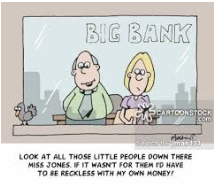
Image: Cartoonstock.com
Bank of American came in first, followed by JP Morgan. DS News, an online newsletter for the mortgage servicing industry, reports the tally.
Political Ads
Posted by Cliff Tuttle| February 22, 2018 | © 2026
No. 1,425
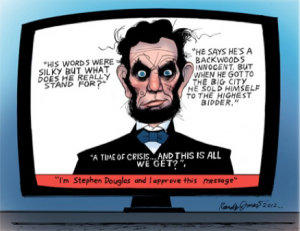 The Achilles heel of advertising, and political ads in particular, is that they are constantly being rebroadcast. Over the course of re-listening you have an opportunity to think about and evaluate what is being said. Statements that might sound ok, if heard once, often fail to withstand even mild scrutiny.
Ads sponsored by the national committees are especially vulnerable. The overall tone is usually mean-spirited. The obvious appeal to bias is, upon reflection, insulting. Do they really believe I think like that?
They say that attack ads work. Maybe they do in many cases. But they also have the disadvantage of repeating the name of the opponent. After repeated viewing, I actually learn the names of candidates that were unknown to me and quickly forgotten on the first few repetitions.
However, there is one ad being broadcast in the current cycle which I think stands head and shoulders above the others. I won’t tell you which candidate put it out because this blog does not give endorsements. The message is, in my opinion, both fair and persuasive. It points out that the candidate has unique training and experience that would qualify him for the job he seeks. Although the ad doesn’t say so, it is clear from the way it is presented that his opponent is unlikely to have a matching qualification.
Of course, one good ad does not a better candidate make. But it certainly hits the bulls eye.
CLT
Welcome
CLIFF TUTTLE has been a Pennsylvania lawyer for over 45 years and (inter alia) is a real estate litigator and legal writer. The posts in this blog are intended to provide general information about legal topics of interest to lawyers and consumers with a Pittsburgh and Western Pennsylvania focus. However, this information does not constitute legal advice and there is no lawyer-client relationship created when you read this blog. You are encouraged to leave comments but be aware that posted comments can be read by others. If you wish to contact me in privacy, please use the Contact Form located immediately below this message. I will reply promptly and in strict confidence.
Recent Posts
- Sheriff Sales in the COVID-19 Era
- MORTGAGE FORECLOSURE: Cares Act creates gigantic opportunity for borrows under federally-backed and owned mortgages.
- PA Appellate Courts Schedule Arguments Using Electronic Media
- US Supreme Court holds that juries must render unanimous decisions in state criminal cases
- Signs of the Times — the future shortage of dentists.