Proud Member of the Rapid Response Team for:

Click Here To Learn More About How You Can Help
Or
Call 412-378-8779
Categories
- 2012
- 2013
- 2016
- 2017
- 2018
- Advertising
- Advocacy
- Amazing!
- Appellate Practice
- Apps for Lawyers and Others
- AVVO Answers
- Bankruptcy
- Blawging
- Business
- Casa San Jose
- Case Update
- Christmas!
- Civil Litigation
- Civil Rights
- Civility and Courtesy in the Practice of Law.
- Congressional Redistricting
- Constitutional Law
- Construction Law
- Consumer Protection
- Contract Law
- Coronavirus
- Courthouse Scenes
- COVID-19
- Credit Card Collection Litigation
- Criminal Law
- Cyber security
- Decision making
- Employment Law
- Encore Post
- Environmental Law
- Estates and Trusts
- Ethics
- Evidence
- Fair Housing
- Fake News
- Family Law
- Fifty Years Ago
- fracking
- Future of the Law
- Great Lawyers
- History
- Holidays
- How to . . .
- Humor and Satire
- Immigration
- insurance
- Jack Sez
- Landlord and Tenant law and litigation
- Lawyering
- Legal Education
- Legal Ethics
- Legal History
- Legal Marketing
- Legal Technology
- Legal Writing
- Life Affirmation
- Life on the Internet
- Links
- Milestones
- Mortgage Foreclosure
- News Commentary
- Oil and Gas
- On line chicanery
- On-line Security
- One Hundred Years Ago
- Oriegate
- Orphan's Court Practice
- Personal Privacy
- Personal Productivity
- Phishing
- Pittsburgh
- Pittsburgh Legal Back Talk
- Pittsburgh Legal Community
- Pokemon Litigation
- Politics and Government
- Post September 11
- Practice of Law
- Privacy
- Property Assessments
- Real Estate
- Real Estate Contracts
- Reassessment 2012
- Retweets
- Right to Reputation
- SCOTUS
- Screenshots!
- Security and Privacy
- Senior Lawyers
- Seven Foundations of Time Mastery for Attorneys
- Signs of the Times
- Solo by Choice: The Review
- Tell Us Something . . .
- Ten Years of Pittsburgh Legal Back Talk
- Tenth Anniversary
- Tenth Anniversary Year of PLBT
- The continuing American Revolution
- the Review
- trademark and service mark
- Trends in the Law
- UTPCPL
- Vocabulary Word of the Day
- Weekend Book Review
- Winners and Losers
- Words Lawyers Use
- Workers Compensation
- Zoning
Judge Wettick Holds that Verification by an “Authorized Representative” of Party Does Not Satisfy the Rules of Civil Procedure.
Posted by Cliff Tuttle| May 23, 2011 | © 2026
No. 620
Complaints in mortgage foreclosures and credit card cases are frequently verified by individuals who are not employees of the plaintiff, but of some service company engaged by the plaintiff for that purpose. Judge Wettick, as the judge handling preliminary objections in arbitration cases, has held that such verifications do not comply with Rule 1024(c), which provides the conditions under which individuals who are not parties may make a verification. The decision, which does not take much more space than would be required to explain it, is reproduced below.
Since Judge Wettick sustained the preliminary objections, the plaintiff filed a new verification by someone else, claiming to be an “authorized agent”, without further explanation. The renewed preliminary objections will be argued on June 3, 2011. The opinion below was reported in the May 3 edition of the Pittsburgh Legal Journal.
*********************************************
Citibank (South Dakota) N.A. v. Paul A. Mszyco
No. AR 10-004428.
Defendant’s preliminary objections requesting that I strike plaintiff’s Verification to Amended Complaint are the subject of this Opinion and Order of Court. The Verification reads as follows:
Verification
Sherri Smith is an employee of Citicorp Credit Services, Inc., (USA) which is by contract the service provider for plain- tiff Citibank (South Dakota), N.A. retained to perform services including but not primarily limited to collecting delinquent debt. I am authorized to make this verification as attorney-in-fact for plaintiff under powers of attorney from plaintiff to Citicorp Credit Services, Inc. (USA) and to me. The foregoing averments of fact in the within pleading are true and cor- rect to the best of my knowledge, information and belief. I understand that the statements made herein are subject to the penalties of 18 Pa. C.S. Section 4904, relating to unsworn falsification to the authorities.
Date: 11-3-10 Signature Pa.R.C.P. No. 1024(c) is the relevant provision within the Pennsylvania Rules of Civil Procedure. It reads as follows:
(c) The verification shall be made by one or more of the parties filing the pleading unless all the parties (1) lack suf- ficient knowledge or information, or (2) are outside the jurisdiction of the court and the verification of none of them can be obtained within the time allowed for filing the pleading. In such cases, the verification may be made by any person having sufficient knowledge or information and belief and shall set forth the source of the person’s information as to mat- ters not stated upon his or her own knowledge and the reason why the verification is not made by a party.
Defendant correctly states that the Verification upon which plaintiff relies does not comply with Rule 1024(c).
According to the Verification, Sherri Smith is not an employee of the plaintiff. The first sentence of Rule 1024(c) requires that the verification be made by one or more of the parties filing the pleading.
There is an exception where every party lacks sufficient knowledge or information. In this situation, Rule 1024(c) requires the person making the verification to state the reason why the verification is not made by a party. Ms. Smith’s Verification does not comply with Rule 1024(c) because it does not state that all of the parties lack knowledge or information or offer any other reason for the failure of a party to make the verification.
Furthermore, Ms. Smith’s Verification does not comply with the requirements of the second sentence of Rule 1024(c) that she set forth the source of her information as to matters not stated upon her own knowledge. Compliance requires, for example, that she include within the Verification a statement that she has sufficient information to make the Verification and a description of the source of her information.
Plaintiff correctly states that substantial compliance is the appropriate standard in determining whether a verification has com- plied with the rules. See Monroe Contract Corp. v. Harrison Square, Inc., 405 A.2d 954 (Pa. Super. 1979). However, the core of Rule 1024(c) consists of the requirements that a party verify the pleading unless all parties lack sufficient knowledge or information and belief and that a nonparty who makes the verification state that he or she has sufficient information to make the verification and describe the source of the information. If these requirements may be ignored, there are few requirements that remain.1 See Rupel v. Bluestein, 421 A.2d 406, 414 (Pa. Super. 1980) (“This insistence upon at least a properly verified complaint may seem ‘techni- cal,’ but no apology need be made for that. The rules are clear, and the requirements easily satisfied.”
Plaintiff relies on the provision within the Verification that she is “authorized to make this verification as attorney-in-fact for plaintiff under powers of attorney from plaintiff to Citicorp Credit Services, Inc. (USA) and to me.” However, this provision does not make Sherri Smith a party and Rule 1024(c) requires that a verification be made by a party. The requirements of Rule 1024 would become meaningless if a party could circumvent these requirements simply by authorizing a third person to make the ver- ification in a lawsuit brought by that party.
1 As defendant states in his Brief in Support at 6: “In light of the well-known epidemic of ‘robo-signing’ arising out of the cur- rent . . . mortgage foreclosure crises, the Court must be vigilant to ensure that all pleadings are verified in the manner required by Pa.R.C.P. No. 1024(c).”
ORDER OF COURT On this 15th day of March, 2011, upon consideration of defendant’s preliminary objections, it is hereby ORDERED that the
November 3, 2010 Verification of Sherri Smith is stricken and that an amended verification may be filed within thirty (30) days. In accordance with a ruling made from the Bench, it is also ORDERED that Count II—Account Stated, is stricken.
BY THE COURT: /s/Wettick, J.
From the Blogroll: 22 Tweets Interviews Italian (from Italy) Family Lawyer.
Posted by Cliff Tuttle| May 19, 2011 | © 2026
No. 619
Check out 22 Tweets from our blogroll in the left margin. Here is the current post.
@tsolignani

Family Law Attorney
Author of Guida alla separazione e al divorzio
–
Today we’re tweeting w/ @tsolignani: Italian lawyer, writer, blogger, dad, geek, Apple user
- @Tsolignani, thank you for joining us on Twitter. Tell us, who is @Tsolignani?
I was born in 1969 in Modena, Italy, where I currently live and work. I like to innovate the practice of law whenever I can
– - Tell us about your law practice.
A small multipractice firm, with around 12 atty’s, located in the sorroundings of Modena, powered by Apple and Ubuntu pc’s
– - What type of clients do you represent?
Several. I like family law, but also traditional estate cases and generally matters where new technology is involved.
– - And what would you say is the single most important legal issue affecting your clients?
Well, I guess you cannot find a single one. When hiring a lawyer, people would just like to know whether or not their …
candidate could be able to handle their issues, which are always different, as a matter of fact …
we don’t care so much about specialization: trying to be clever, brilliant and able to work together are better skills l
– - Interesting perspective. What do you tell every new client before you start working for them?
Again, people just wanna know 3 things: whether you can handle their issue, how much time and money it’ll takes…
So, this I what I usually tell them, then they have to accept my fee and other conditions and eventually we start…
Whenever I can, most of the time, I do flat fees, so that people can exactly know the cost in advance. They like it.
– - Tell us about one of the more significant client representations you’ve had.
The italian code of conduct forbid to mention people you worked for as a lawyer. So that I cannot tell names. But one …
of the most interesting experiences I had was being expert witness before the Crown Court, in the UK, into an extradition…
case requested by the italian government, where the court denied the extradition as for my advice
– - Why do your clients hire you?
It’s up to them and it’s always different. Someone wants a «young» firm, someone else a lawyer one can email or DM …
on twitter. Some others are Italian but live abroad and need a lawyer in the country. There really are many cases.
– - What’s the most active area of your practice at the current time? Is that typical?
I guess family law and, yes, it’s typical, but, again, beware family could embrace every branch of the law: think …
f.i. to a divorcing couple who owns a corporation whose main assets are intellectual goods; it’s a divorce, but you …
surely would need to work with an IP lawyer.
– - Indeed. How has personal (family) law in Italy changed over past ten years? What do those changes mean for your clients?
Not as much as the society did and there would be really many things to change. Other european countries, such as Spain…
and France did the innovation we missed, f.i. in marriages, allowing homosexual couples, but there would be much more
– - And how is the legal profession evolving in Italy? Do you see similar challenges as we do in the US (eg fixed fees)?
Unfortunately, the legal profession in Italy is not evolving at all: rather it is getting worse day by day, due to …
several reasons, such as judiciary system inefficiency, huge numbers of practitioners and many others …
fixed fees: a law was enforced about that and some laywers like me do fixed fees, but the most still do not
– - Change is hard everywhere…. How do you describe what you do to people you meet at a cocktail party?
I know many lawyers create an «audio logo» to spend in such cases, but I prefer not to mention my work while partying …
when someone insists, I talk about what I do, which is not necessarily the legal profession, but maybe a book or article
– - When did you become active on Twitter? What were your objectives then? Have they changed?
3 years ago. When trying some new «net toy», my aim is just to have fun and satisfy my curiosity. But I have to say …
twitter later did the trick for me. I use it everyday, have fun and many a good clients found me over there
– - You blog at http://bit.ly/dUDVl1. Who do you write it for? Why should they read it?
For the common people, not for other lawyers. They can read to understand some basic notion and principles of the law
– - You mentioned clients finding you on Twitter: can you quantify the new engagements you’ve got from Web 2.0?
Well, it is far for getting near my core business but it is promising and worth keep working on it
– - Tell us about “Guide to Separation & Divorce.” It’s a difficult subject. How do you make it less so for your clients?
If there’s something we lawyers exists for, if any, is explaining the law to common people in an effective way. We have …
change our language and literally translate in simpler terms what we are used to think in a more complicated form, but …
I guess it is worth it. A lawyer is a good one only if he or she can communicate with everyone and turn simple what is not
– - Very well put. What is the most significant issue currently facing the legal profession?
The fab 5? 1 get hired 2 do the work 3 get paid 4 try to save some money from bills and taxes 5 still keep smiling
– - 🙂 What will the legal landscape look like in 10 years?
We Italians live in an idle country where, when something changes, often gets worse. I have no idea, I just know I have …
2 children and I hope neither of them gets to be a lawyer, there are many more funny and interesting things to do, as yet
– - What would you do if you weren’t a lawyer?
I adore writing and sometimes I think about trying some short stories or even a novel, but I do not think I ever will 🙂
– - How do you want to be remembered?
As a man with whom you could talk to and get some answer, some advice, some suggestion or even comprehension. A man who …
helped someone, sometimes.
– - What do you do when you’re not working?
As of today, mostly playing with my children. But I like «creative idling» too and «practice» whenever I can
– - What advice can you pass along to lawyers currently under- or unemployed due to the economic crisis?
First off: choose whether you still want to practice or not. There are many other interesting things to do and where you …
you can earn the same or even more money. If you decide to stay a lawyer, then prepare to do much more the marketing side
– - And our final question of the interview: what advice do you have for people going to law school today?
Try to get the best from the school experience and, once out, choose very carefully the career, maybe trying with stages
Very good advice, for both groups. Thank you for tweeting with us today; I enjoyed learning about you and your practice
I have learned so much too. Thank you for interviewing me. Have a nice day.


Don’t Miss Seeing Garrow’s Law.
Posted by Cliff Tuttle| May 18, 2011 | © 2026
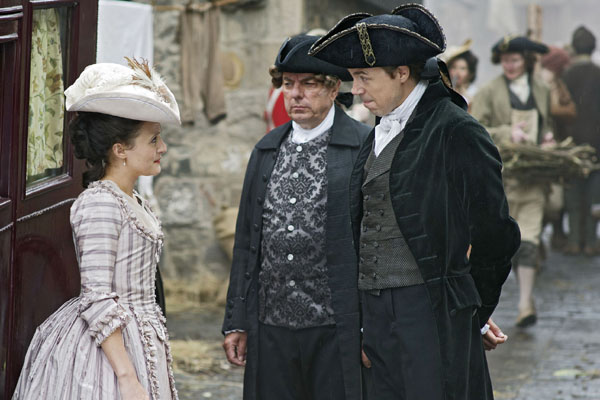
Garrow’s Law
Posted by Cliff Tuttle| May 14, 2011 | © 2026

 No. 617
GARROW’S LAW, is a gripping legal drama, which has appeared on the BBC, set in late 18th Century. It is a fictionalized account of the early career of Barrister William Garrow, who flaunted convention by his vigorous and confrontational questioning of witnesses. Garrow arrived in an era that did not tolerate barristers confronting and accusing witnesses or being otherwise disagreeable. He is credited by singlehandedly changing that custom by example.
The series begins with Garrow’s first case, one he loses, but not without displaying a skill in unconventional cross-examination that would become his trademark. While giving all to the defense of his client, he is very nearly locked up and barred from the court by a testy Judge, Sir Francis Buller, another real historical figure. Although Buller continuously harasses Garrow from the bench and instructs the jury in a fashion calculated to insure a conviction, he becomes intrigued by the admissions that Garrow pulls out of hostile witnesses and slowly develops a grudging respect for this unconventional advocate.
These episodes are worth watching simply as historical drama, with authentic costumes and settings and well-researched scripts. They create a memorable tableaux of the energetic bustle of criminal trials in the Old Bailey during a very different era, but shedding light on the origins of the present, as all good historical fiction does. However, lawyers (or at least some of us) will find Garrow’s skillful questioning of witnesses to be of equal importance. He is always aware of the jury and makes untruthful witnesses admit the truth with their face.
When Garrow confronts a witness with a key document that turns out to be two blank sheets of paper, he incurs the wrath of Judge Buller who “will have no such tricks in my courtroom.” But Garrow explains that the jury has nevertheless seen the witness’s face and knows the truth.
In another case, he demolishes the prosecution’s medical expert, by demonstrating that (1) this doctor had little practical experience in assisting childbirth, (2) had never encountered the specific situation presented in the case, (3) didn’t recognize the surgeon’s tool used to cut an umbilical cord wrapped around the infant’s neck and, in the coupe de grace, (4) confronting him with a passage from an authoritative medical treatise that the witness cannot refute.
More than once, when a prosecuting witness cannot recall his or her own conflicting testimony from the preliminary hearing before the magistrate, Garrow chides the witness to do better, since a life is at stake. Then, by a gradual line of questions, Garrow forcibly refreshes the witness’s recollection and extracts the key admission.
Unfortunately, there are only four one hour episodes of this gem available, with another series in production. May there be many more. Check for Garrow’s Law on Netflicks.
CLT
A Little Thinking on the Future of Assessments, Please.
Posted by Cliff Tuttle| May 13, 2011 | © 2026
No. 616
 The candidates for Allegheny County Executive all have something to say about assessments. Rich Fitzgerald stated in a Trib article in January:
“I am going to stop the county-only assessment. If we are going to a reassessment statewide, fine, but don’t single out Allegheny County.”
That seems to be the the position of his Democratic opponent, Mark Patrick Flaherty as well. There ought to be a uniform statewide reassessment system, he says, and (here’s the the big part) there should be a statewide moratorium on new reassessments while the legislation is drafted, studied, debated and finally passed.
Republican candidate Raja says more or less the same. His approach to all such problems is to get all the players together in a room and hash it out. His Republican primary opponent, Charles McCullough offers more of the same. In February, he and three other Republicans on the Allegheny County Council presented a petition to Judge Wettick to place a moratorium on the 2012 reassessment while the legislature enacts a statewide uniform system. That petition was rejected by the court, stating that it was too late and presented by the wrong persons. McCullough hopes to be elected County Executive and do it then.
The genesis of all this was that the current Allegheny County assessment system, whose principal author was County Executive Onorato, has been held unconstitutional by the state Supreme Court. It was modeled upon a practice widely employed in other counties, fixing assessments upon a base year — in Allegheny County it is 2002. The Supreme Court found this approach unconstitutional because the evidence presented at trial demonstrated that some (but not all) neighborhoods are experiencing free-fall in sales prices. Those neighborhoods are being taxed on 2002 values that are higher than current values.
While the next County Executive must grapple with the demonstrated inequality of the current assessment scheme, none of the candidates have a clue what to do,except to observe that it is unfair to single out Allegheny County. Because all of the candidates lack any serious (pronounced “non-political”) thoughts on how to make reassessments better, we are guaranteed a lack of leadership on this front from whoever becomes the Allegheny County Executive.
Unless the state legislature comes up with some new ideas, the only practical outcome will be to apply the court mandated system to every county. That might address the comparative advantage the bedroom counties adjoining Allegheny County now enjoy in attracting new development, but little else.
Truth is, any assessment system based upon past sales is an imperfect model. It relies upon a selectively-recorded history, because it has no choice. The current system of tallying and applying data, known as mass appraisal because it seeks to appraise properties in large quantities, is flawed. The flaws have never been as apparent as they are now. In a falling market, assessments are higher than the true fair market because the mass appraisal system relies upon prices from the past that can no longer be obtained. In a rising market, the opposite is true.
The typical model for mass appraisal is very good at tracking and accounting for increases in sales prices. But not so good in the other direction. Typically, when the fair market value of a property falls below the mortgage balance, most would-be sellers cannot sell. They must simply stay off the market. Thus, the properties that are increasing in value or holding steady are driving the sales statistics higher, but do not reflect the general state of affairs. Meanwhile, foreclosure properties, unsold in large numbers, keep other sellers on the sidelines.
In such an environment, the sales history compiled for assessment purposes presents a distorted picture of the true state of affairs.Lowball sales from foreclosures may actually be culled out as non-arms length transactions, further distorting the aggregate value.
The real value of many properties in today’s market is best measured, not by the price of comparable sales, but by their rental value. In locations where values are declining, a house can be rented at a return that exceeds the return on the sales price. These properties are off the market, too.
Then, there is the fact that mass appraisal by its nature deals in rough numbers. Fee appraisers, the ones who make appraisals for mortgage lending, use a more sophisticated valuation system, making mathematical adjustments to bring the value into line with the true situation, as seen by a typical buyer and seller. For example, if work needs to be done, the true value should reflect the cost of the work. Properties that are sold frequently undergo makeovers that result in a sale. But “comparable” properties needing work are often valued by mass appraisal systems as though they are equal to the refurbished properties, which they definitely are not.
Such adjustments, which are peculiar to each property, make a difference. An appraisal system that ignores these factors because they are deemed too costly to record, shortchanges owners whose properties need work.
If the next group of leaders are going to make a meaningful contribution to the real-estate based taxation system, they are going to have to hire experts who can come up with technical improvements to the court ordered system that can be supported by data. This is not an easy task, but the alternative is to remain mired in an unfair system. Change may require the gathering of data not previously collected which would be applied by using algorithms not yet invented. Political solutions, such as the base year bandaid, will not perform the task.
In the meantime, property owners must protect themselves. Certain revenue-hungry school districts (and some municipalities) are appealing assessment changes after sales. They are often taking the position that the property should be assessed at the full price (or close to it) without regard to the fact that other properties are under a 2002-based system. Others will produce 2002 sales data that is heavily skewed on the high side. It is important to file and pursue a timely appeal. In order to win, you must be prepared to produce 2002 sales data that makes sense — better sense than the data produced by the opposition. Unless you know a good deal about real estate and know how to find 2002 sales data, it is a very good idea to hire a lawyer (not a non-lawyer) who knows the system.
Why a lawyer? Both sides can appeal and school districts frequently do so. Non-lawyer “experts” are comfortable in the informal first round of appeal,but are not experienced under the more formal procedures utilized by the Board of View. While you can always represent yourself before the Board of View, you may find yourself stuck in a procedural or legal quagmire with no opportunity to fix it.
And of course, once the 2012 reassessment is enacted (even if delayed) it will be necessary for all property owners to consider whether to appeal and, if advisable, to file it promptly and be prepared when the hearing date finally occurs.
CLT
Tags: Charles McCullough > Mark Patrick Flaherty > Raja > Rich Fitzgerald
The Exception that Proves the Rule: OBL.
Posted by Cliff Tuttle| May 11, 2011 | © 2026
No. 615
 Pakistan is insulted that it wasn’t consulted before the US conducted a raid in its territory.
Answer: Get over it. Talk to you and OBL would have been gone, probably forever.
Obama’s Adult Sons want to know why their father wasn’t arrested by the Americans and held for trial.
Answer: Its war and he was in Pakistan.
Was justice done?
Answer: A combatant (the commander in chief) in a war was neutralized. Justice is irrelevant.
The question whether the killing of Bin Laden was legal under international law is succinctly discussed in the Huffington Post. Its worth reading.
CLT
On-line Law School Anyone?
Posted by Cliff Tuttle| May 1, 2011 | © 2026
No 614
Above the Law found an article on the internet about a 16 year old who graduated from Washington State University with a high GPA and now wants to go to law school on-line. In the inimitable ATL style, they called her stupid.
Can you really go to law school on-line? Apparently you can, but the only State that presently accredits on-line legal education is California. It doesn’t sound like the kind of decision a prodigy university graduate would make, or does it?
Most of us graduated from college about five or six years later than she did. It appears from the article that the secret to her early success was that she took all of her college courses on-line. Or, in other words, she completed college at her own pace — the rapid one. If she completes law school at the same accelerated pace as her prior education, she will be taking the bar exam before she gets to vote in a general election. What’s wrong with that?
What in traditional law school experience cannot be duplicated — or perhaps done better — on-line?
Well, there is all that interaction with your classmate as the group feels its way through the first year together like so many blind people. But perhaps the benefit of group experience is exaggerated. And perhaps we could have learned a lot faster if we hadn’t been exposed to so many wrong answers.
In a traditional classroom, only one student recites while the others listen. In an on-line class, everyone can be required to present case summaries and discuss the issues they raise every time. Then, samples of really good answers could be provided for comparison.
Of course, on-line education is still in the process of catching on. But in case you haven’t noticed, the times are a-changing. Four dollar gas means that the benefit of staying at home in front of a computer, as opposed to traveling into the City, is starting to look pretty appealing. And then there is the cost of providing all those live lectures. Are the Socratic questions and answers really so unique that the dialogue could not be conducted between student and computer?
Legal resources, including research materials are increasingly being provided via the internet. The electronic law school just might prove to be the better vehicle for learning to use them.
So, don’t count out the 16-year old college grad turned distance legal scholar. By the time we drive to our traditional law office to start our traditional day, she will be miles and miles ahead of us on the electronic road.
CLT
Happy Birthday, Adrian Baron, April 29, ?
Posted by Cliff Tuttle| April 29, 2011 | © 2026
No. 613
And thanks for the present.

I own this Major Award and you don't.
The Major Award has arrived. It is everything it was advertised to be. It even plugs in and lights up — a real lamp.
Of course, there are more important things to pay attention to, like the Windsor-Middleton Wedding. Well, I guess that puts it all in perspective, doesn’t it?
By the Way, Pittsburgh, there wasn’t a Super Bowl trophy in town this year, there won’t be a Stanley Cup here either. And the Pirates will once again be watching the World Series on TV.
But we have the First Annual Law Baron Award. Savor it.
CLT
Happy Birthday to You! Happy Birthday to You!
Posted by Cliff Tuttle| April 28, 2011 | © 2026
No. 612

Read 'em and weep!
Barack Hussein Obama was born on August 4, 1961. He was born again on April 27, 2011.
The most interesting event of the day, however, was when the media caught up with that carnival barker, the Donald, who had the audacity to proclaim that he had done something really, really good. Say again?
CLT
COMMENTS:
- Adrian Baron
April 28th, 2011 @ 2:58 am editAnd to think, I thought this was directed at me.
I was going to tell you that my birthday is on the 29th - Cliff Tuttle
April 28th, 2011 @ 9:42 am editI’ll have to see an original birth certificate.A short form will not do. I’ve heard rumors you were born in Poland. Everyone knows real Americans only speak English.
CLT
Beware the Bogus Avvo Answer!
Posted by Cliff Tuttle| April 28, 2011 | © 2026
No. 611
AVVO Answers can be enlightening and helpful. But some Answers are better than others. And some are dead wrong. Consider the first Answer below — clearly wrong — which was given by a California lawyer who gave the most answers this past week in the Lawsuits and Disputes category. She is in such a rush to answer more questions that she fails to give a correct (or even adequate) answer to this one. The second answer is better, but still polly parrots the erroneous first answer. It focuses on the idea that a judgment in this case may not be worth anything. Perhaps, but not the answer to the question asked.
Of course, the third Answer is correct.
My friend is being sued by their landlord’s insurance company for an accidental fire in which they lost their rental home.
Edit practice area
They have no renter’s insurance. Can they be liable for $45,000 for an accidental fire?
This question will be closed to new answers in 4 days.
Answers (3)


CLT
« go back — keep looking »
Welcome
CLIFF TUTTLE has been a Pennsylvania lawyer for over 45 years and (inter alia) is a real estate litigator and legal writer. The posts in this blog are intended to provide general information about legal topics of interest to lawyers and consumers with a Pittsburgh and Western Pennsylvania focus. However, this information does not constitute legal advice and there is no lawyer-client relationship created when you read this blog. You are encouraged to leave comments but be aware that posted comments can be read by others. If you wish to contact me in privacy, please use the Contact Form located immediately below this message. I will reply promptly and in strict confidence.
Recent Posts
- Sheriff Sales in the COVID-19 Era
- MORTGAGE FORECLOSURE: Cares Act creates gigantic opportunity for borrows under federally-backed and owned mortgages.
- PA Appellate Courts Schedule Arguments Using Electronic Media
- US Supreme Court holds that juries must render unanimous decisions in state criminal cases
- Signs of the Times — the future shortage of dentists.