Proud Member of the Rapid Response Team for:

Click Here To Learn More About How You Can Help
Or
Call 412-378-8779
Categories
- 2012
- 2013
- 2016
- 2017
- 2018
- Advertising
- Advocacy
- Amazing!
- Appellate Practice
- Apps for Lawyers and Others
- AVVO Answers
- Bankruptcy
- Blawging
- Business
- Casa San Jose
- Case Update
- Christmas!
- Civil Litigation
- Civil Rights
- Civility and Courtesy in the Practice of Law.
- Congressional Redistricting
- Constitutional Law
- Construction Law
- Consumer Protection
- Contract Law
- Coronavirus
- Courthouse Scenes
- COVID-19
- Credit Card Collection Litigation
- Criminal Law
- Cyber security
- Decision making
- Employment Law
- Encore Post
- Environmental Law
- Estates and Trusts
- Ethics
- Evidence
- Fair Housing
- Fake News
- Family Law
- Fifty Years Ago
- fracking
- Future of the Law
- Great Lawyers
- History
- Holidays
- How to . . .
- Humor and Satire
- Immigration
- insurance
- Jack Sez
- Landlord and Tenant law and litigation
- Lawyering
- Legal Education
- Legal Ethics
- Legal History
- Legal Marketing
- Legal Technology
- Legal Writing
- Life Affirmation
- Life on the Internet
- Links
- Milestones
- Mortgage Foreclosure
- News Commentary
- Oil and Gas
- On line chicanery
- On-line Security
- One Hundred Years Ago
- Oriegate
- Orphan's Court Practice
- Personal Privacy
- Personal Productivity
- Phishing
- Pittsburgh
- Pittsburgh Legal Back Talk
- Pittsburgh Legal Community
- Pokemon Litigation
- Politics and Government
- Post September 11
- Practice of Law
- Privacy
- Property Assessments
- Real Estate
- Real Estate Contracts
- Reassessment 2012
- Retweets
- Right to Reputation
- SCOTUS
- Screenshots!
- Security and Privacy
- Senior Lawyers
- Seven Foundations of Time Mastery for Attorneys
- Signs of the Times
- Solo by Choice: The Review
- Tell Us Something . . .
- Ten Years of Pittsburgh Legal Back Talk
- Tenth Anniversary
- Tenth Anniversary Year of PLBT
- The continuing American Revolution
- the Review
- trademark and service mark
- Trends in the Law
- UTPCPL
- Vocabulary Word of the Day
- Weekend Book Review
- Winners and Losers
- Words Lawyers Use
- Workers Compensation
- Zoning
Copy, Cut, Paste, Copy. The Orie Case Morphs into Two Cases.
Posted by Cliff Tuttle| March 4, 2011 | © 2026
_______________________________
Photo: KDKA Television.
______________________________
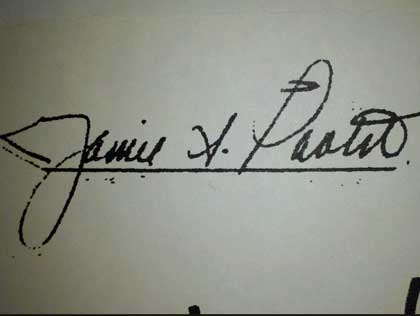
The dramatic events of the Orie trial, where a mistrial was declared after the jury had begun to deliberate, turned on whether the signature of the key prosecution witness on at least two documents in evidence had been forged. See the little loop that intersects the top of the P? Well, it doesn’t belong there. It appears to be part of another signature from another document, cut and pasted.
Here’s a story that illustrates how it can be done.
Once upon a time, back in the seventies, there was a divorce. The ex-husband decided to get even with his former wife’s lawyer. He had a letter from the lawyer, scissors, glue and a copier. He copied the letter and cut off the letterhead at the top and the signature at the bottom. Then he composed another letter, addressed to the members of the Bar Association, inviting them to join in celebrating Gay and Lesbian Law Week. In order to get into the swing of things, the letter suggested ordering some explicit videos from the accompanying brochure. After pasting the letterhead on the top of the fake letter and the signature on the bottom , he copied a few thousand and sent one to every lawyer in town.
And that is all it takes. Any amateur can do it.
Of course, the same amateur can also make a forged check the same way, rather easily. Did you hear the one about the freelance writer who added a few zeros to a check from a magazine, using a computer with no special software? It had a mechanically produced signature on the original, so its use on the fake check attracted no attention. Color copiers are also the reason why the United States Treasury has changed its currency. Its too easy.
At one time, photocopied evidence was viewed with suspicion. Lawyers would demand originals or a convincing explanation why the originals were not available. Today we accept copies that could be forged with little or no scrutiny. Demanding an original signature is considered by some to be an early sign of mental illness.
Our predecessors were not so trusting. They designed deeds, mortgages and notes on long continuous pieces of paper, which folded over, accordion style. This made it impossible for a forger to replace one of the pages. With the advent of computer-generated documents, this wholesome practice was dropped and no one objected.
The Orie case has now taken a turn into uncharted territory. This case was pulled from the jury while it was deliberating. Defense counsel, William Costopoulos, raised the issue of double jeopardy. But as a player in the creation of the current state of the law on double jeopardy, he must know how difficult that road will be under the facts in this case. There are double jeopardy cases where the mistrial was caused by prosecutorial misconduct or because the prosecution induced the defense to call for a mistrial. But this is probably the first double jeopardy case in Pennsylvania involving defense misconduct.
This case will break legal ground for another reason. The prosecution is conducting an investigation into the process whereby the tainted exhibits, and perhaps many more, were created. This runs directly into the sacred right of lawyer-client privilege. It is unlikely that the privilege will be voluntarily waived. Can the judge order the defense to cooperate? If so, how far does that cooperation extend? If not, how can the investigation be accomplished? These and related issues will involve a trip to the Superior Court at least — probably beyond. Of course, the Senator’s political career cannot survive while all of this is sorted out.
The Orie corruption/forgery case will take at least a decade to run its course. It will probably involve multiple appealsbefore another trial can be conducted. A visit to the United States Supreme Court is not out of the question — the High Court decided a Pennsylvania double jeopardy case not too long ago. But there may never be a satisfactory answer regarding the provenance of the questioned documents.
CLT
No. 590
Tags: forgery > Jane Orie > mistrial > William Costopoulos
Pittsburgh Legal Back Talk Wins Major Award. Greatest Ever.
Posted by Cliff Tuttle| March 3, 2011 | © 2026
 I learned late last night that Pittsburgh Legal Back Talk has been named the recipient of the First Annual Law Baron Award, bestowed by Nutmeg Lawyer, our second most favorite blawg in the universe.
This is a truly major award, as anyone who watches TV at Christmastime will know.
Adrian Baron, the author of Nutmeg Lawyer, says that my guest post, Why Blog? 10.5 Good Reasons, has been viewed 19,000 times on his blog. Imagine that — over three times the membership of the Allegheny County Bar Association.
Thank you, Law Baron. When I started PLBT in July 2008, almost 600 posts ago, I never thought it would come to this.
CLT
Postscript: No, the award was NOT announced in the Nutmeg Lawyer on April 1. It was March 1. Unlike Christmas and the Superbowl, April Fool’s Day is not celebrated with a one-month run-up period.
St. Patrick’s Day Alert: Public Urination is Prohibited in the City of Pittsburgh.
Posted by Cliff Tuttle| March 2, 2011 | © 2026
No. 588
The City of Pittsburgh passed an ordinance in 2009 [ No. 2009-1731] specifically prohibiting public urination. There is no such offense in the Pennsylvania Crimes Code, so the City Counsel felt that it needed one. Thus, this offense is tried in the City Housing Court. The Crimes Code does, however, contain a prohibition against public drunkenness and there is always the old favorite, disorderly conduct.
The City Counsel felt that a special ordinance was required for this serious matter, since they judged it to be a particular problem in the South Side bar district on busy nights. This ordinance has also been proven to be very useful to police on two other occasions: after Steeler games and on St. Patrick’s Day.
One interesting aspect of this ordinance is that it establishes a separate violation for failing to clean up afterward. Does anyone disagree that a person who who would actually attempt to clean up after urinating outdoors must be very drunk indeed? Yet the City has established it as a duty. The performance of this duty is further complicated by the likelihood that the perpetrator has been apprehended by police while still performing the first act and almost certainly is not carrying any cleaning materials. Thus, the poor soul can be fined up to $500.00 for making the mess and another $500.00 for failing to clean it up.
The ordinance does not create much opportunity for a defense. Although consent by a private property owner is technically a defense, the Magistrate is unlikely to believe it. I suppose that this defense might work if one is caught urinating in one’s own back yard.
The ordinance contains no mention of one obvious defense — medical emergency. As attested by TV commercials aimed at persons over 50, some of us are subject to sudden urgent attacks (even when not drinking alcohol) at a time when no known restroom is available. If you are one of those people, stay out of the City on Saturday night, after Steeler games and on St. Patrick’s Day. And if you can’t arrange that, wear a diaper.
CLT
Oscar Talk: Why Movie Stars Make More Money Than Lawyers.
Posted by Cliff Tuttle| February 28, 2011 | © 2026
No. 587
Why do movie stars make so much money? Very simple. They have so many people paying them.
When drama was on stage, rather than on film, the compensation of the actor was limited by the number of people in the audience. The same was true of singers and other entertainers, like baseball players. Now they play to audiences of millions. That’s the whole deal.
Not all jobs are capable of such technological multiplication. With the advent of cyberschools, teaching may become one of them. Instead of having a large number of ordinary teachers making ordinary money, we may eventually have a relative handful of talented cyber-teachers making movie star money. Are we as a society better off in the latter case? With the exception of laid off teachers, yes. The lectures will be better and in the aggregate, cheaper. (If a cyber-lecture is not better, somebody with a better lecture to sell will probably displace it.)
And what about lawyers? Can there be super-lawyers paid for the same performance by a clientele of millions, or even thousands? Not really. Class actions may have the capability of creating a mass clientele. But they involve such a small segment of the legal service market that they really don’t count. And a few firms can create a mass clientele for a particular type of case through marketing and then create efficiencies through scale — like personal injury or mortgage foreclosure factories. But even this kind of lawyering, to be done properly, requires service to clients on an individual basis. At best, only a tiny segment of law practice is capable of generating the kind of economies found in the entertainment business.
Actually, that’s good news for lawyers. Clients still need our individual attention.
Only the Names have been Changed to Protect the Innocent.
Posted by Cliff Tuttle| February 25, 2011 | © 2026
No. 586
Today, Adrian Baron tells the story in his blog, Nutmeg Lawyer, about the client who wanted to change his name to Darth Vader. [I’ll give you the link at the end of this post — you are not permitted to run off until I am finished.]
Every Pittsburgh lawyer has been approached by people with too-ethnic, unpronounceable or slightly ribald names who, after much angst, decide to select a new one. Usually, they select an anglican equivalent to their foreign language surname. Some change their first names, too. Fact is, they are only trying to fit in.
Times change. One member of the older generation in the Musmanno clan changed his name to Mussman. Then his son, Superior Court Judge John Mussmano, changed it back. He explained it as a resurgence of ethnic pride, as exemplified by his almost-famous uncle, Pennsylvania Supreme Court Justice Michael Angelo Musmanno.
I wish I had changed my name long ago. But now it is too late. My mother told me that she had considered naming me after her favorite baseball pitcher, Lew Burdette of the Boston Braves. In the end, they opted for the very conventional choice of naming me after my father. While not complaining, I made it clear to everyone from about age seven, that I clearly should have been named Benjamin Franklin Tuttle. I even lobbied hard for that name choice for a sibling, but alas, there would be only sisters.
If only I had had the guts to formally change my name back then. And what a great name it would have been! But now, alas, after a lifetime of networking under my current name, a name change at this late date would be the source of endless confusion. Or perhaps endless mirth and merriment. I would also have to find another wife. She hates it. And my parents — they would probably never understand. Come to think of it, the only person in my family who is likely prefer my new name would be me. Oh, well.
From time to time I think about a man I knew at my first summer job as a teenager. He seemed to know that I would become a lawyer long before I did. He told me that he wanted to be my first client. His perfectly good German name translated into a body part in English and he ardently wanted to change it. He told me he would pay $100.00 as my fee. He’s gone now and I never got him that name change. Why do I feel so guilty about that?
So, as an act of atonement, if there are any readers of this blog who have yearned for a new and better name, send me a message in the contact box in the right-hand column and I will help you achieve that dream. No, not for the unbelievably low fee of $100.00, but — for a limited time only — for the low, low fee of zero. You pay the title searcher and the advertising and court costs. Allegheny County residents only, please.
But I should warn you: The courts take a dim view of people changing their names to avoid creditors or get off child molester lists.
Now go read about how the Nutmeg Lawyer meets Darth Vader.
CLT
Tags: Adrian Baron > Benjamin Franklin > changing a name > Darth Vader > Musmanno > Nutmeg Lawyer
That’s a Marketing Plan!
Posted by Cliff Tuttle| February 24, 2011 | © 2026
No. 585
My colleague Brian Walters was quoted in the Post Gazette this week. He said he found out when he received a call from someone who read the article.
“A new client?” I asked.
“No, ” he said. “Somebody trying to sell me something.”
C
Joe Flom.
Posted by Cliff Tuttle| February 24, 2011 | © 2026
No. 584
The WSJ Law Blog reports that Joe Flom, the lawyer who made an art form of the hostile takeover, died at 87. He was the firm’s first Associate at the present Skadden, Arps, Slate, Meagher & Flom in 1948 and is given major credit for turning the firm into one of the world’s largest and most lucrative.
If you want to learn how a lawyer can grab an opportunity that no one recognized and ride it to greatness, read Chapter 5 in Malcolm Gladwell’s book “Outliers – The Story of Success.”
CLT
Law for the Singularity.
Posted by Cliff Tuttle| February 20, 2011 | © 2026
No. 583
So, Obama made Steve Jobs get up from his sick bed and come to dinner with a group of CEOs of companies like Facebook, Google — you get the gist. And what was the point?
Change was the point. The world of technology is changing so rapidly now that by the time we the ordinary mortals figure out where we are the world has already rocketed far beyond. The only way to get a rough idea of exactly where we might be (and more importantly, where we are going) at any given moment is to be in touch with those on that “cutting edge.” Thus, the dinner.
It has long been a cherished political article of faith that leaders had a choice between maintaining the status quo, which was static, and “change”. Obama himself preached a version that gospel. But, of course, it isn’t true and we all know it. The engines of change are now moving so rapidly without being directed by Presidents or legislatures that the fact is manifest to all.
Perhaps you watched Jeopardy! this past week, where Watson, an IBM Supercomputer that had been programmed to play that game, easily beat the two greatest human champions. In order to make this achievement possible, Watson had to be able to master the nuances contained in natural speech, including clever word-play and double-entendre, the meat and potatoes of Jeopardy! answers and categories. In order to ask the right Jeopardy! question, a contestant must figure out the relationship between the category and the answer. Watson passed the test, aced it, in fact. So what’s next?
What’s next, indeed. The developers of Watson see him as quickly becoming an expert’s expert in fields such as medical science. It only requires a little imagination to foresee the day when artificial intelligence will surpass every benchmark set by the human brain and keep going. When will this epochal event occur?
Believe it or not, some of us may live to see that day. Its called the Singularity, perhaps the greatest event in human history since the invention of human speech. And some of those who have spent a career studying this phenomenon, such as Ray Kurzweil, say that the Singularity is likely to occur on or about AD 2045.
Meanwhile, how is the law keeping up with all this change? Not very well. The law moves slowly, even at a glacial pace. How quickly issues resolve depends to a great extent on what facts show up in what court. It may take a century before clear answers emerge to even the most obvious questions. And in the case of the Singularity, we don’t have even a half-century before the world is turned on its head. Meanwhile, the ever-expanding body of law has already become so unwieldy and complex that no human can pack it all into a single cerebral cortex.
The solution is before our eyes this week. IBM should begin development of a brother to Watson that specializes in the law. Perhaps we’ll call him Marshall, after the Chief Justice who was instrumental in molding the course of American Law. Marshall would be programed with the facts and holdings of every case ever decided in American law and then with a complex series of algorithms designed to apply principles of law with great skill. However, as facts changed and trends developed, the holdings would change. Eventually, Marshall would decide cases. Lawyers would submit briefs and Marshall would consider the arguments carefully, weighing precedent — all precedent — before creating an unbiased, completely logical and totally up-to-the-nanosecond decision. Marshall could even delay decisions until other cases had been briefed and argued, so that a group of cases presenting similar questions could be decided together.
Fairly soon, of course, the members of the bar would be acquiring computers capable of communicating better with Marshall, perhaps predicting the relative probability of each outcome and thus settling cases before submission.
Fortunately or unfortunately, depending on your point of view, I will be 98 in 2045 and dealing with Marshall and other legal supercomputers will probably be somebody else’s problem. I say probably, because Kurzweil says that the genetic problems that cause us to get old, sick and die are well on their way to resolution and by 2045 death will be a matter of choice.
Excuse me if I express a bit of knowing skepticism on that point. The law cannot ultimately defeat progress. But it can delay it for decades in litigation. Long enough, anyway, to assure that the prospect of earthly immortality eludes this generation of lawyers. In other words, ours may be the generation of lawyers to commit suicide in court.
Tags: IBM Supercomputer > Jeopardy! > Obama > Steve Jobs > technology > Watson
A Blast from the Past.
Posted by Cliff Tuttle| February 17, 2011 | © 2026
No. 582
A year ago, when we were coping with snowmageddon, the story of a Hazelwood man who died after repeatedly calling the City paramedics was playing out. Perhaps some of you may remember that several paramedics left anonymous comments on the topic n this blog and I wrote a number of pieces about it.
Well, lately I have been receiving trackbacks from those posts and comments. The first flurry came about the time of the arbitration of a dismissed paramedic and the second was yesterday when the decision reinstating her was announced.
I have no intention of reprising these pieces, but you can find them by scrolling back to last February. The first one is, I think, “View from Foggy Goggle.” Look it up using the search box.
How to Subpoena a Witness in City Court
Posted by Cliff Tuttle| February 17, 2011 | © 2026
No. 581
My source in the Department of Court Records – Criminal Division (pronounced Clerk of Courts) says that lots of lawyers get subpoenas from that office for proceedings in City Court. They aren’t enforceable, of course, but it fools employers.
Well, I’m here to tell you that you can easily get a subpoena to compel attendance a City Court case by going to the window for the appropriate court (Traffic, Non-traffic, Housing) with the necessary information (Case name, number, caption, name and address of witness, date, time). The clerk will prepare it and you serve it. But be prepared to wait a bit.
If you need a subpoena at a District Magistrate’s Office, go to the office and ask them to prepare one. You will have to serve it, however.
CLT
Welcome
CLIFF TUTTLE has been a Pennsylvania lawyer for over 45 years and (inter alia) is a real estate litigator and legal writer. The posts in this blog are intended to provide general information about legal topics of interest to lawyers and consumers with a Pittsburgh and Western Pennsylvania focus. However, this information does not constitute legal advice and there is no lawyer-client relationship created when you read this blog. You are encouraged to leave comments but be aware that posted comments can be read by others. If you wish to contact me in privacy, please use the Contact Form located immediately below this message. I will reply promptly and in strict confidence.
Recent Posts
- Sheriff Sales in the COVID-19 Era
- MORTGAGE FORECLOSURE: Cares Act creates gigantic opportunity for borrows under federally-backed and owned mortgages.
- PA Appellate Courts Schedule Arguments Using Electronic Media
- US Supreme Court holds that juries must render unanimous decisions in state criminal cases
- Signs of the Times — the future shortage of dentists.