Proud Member of the Rapid Response Team for:

Click Here To Learn More About How You Can Help
Or
Call 412-378-8779
Categories
- 2012
- 2013
- 2016
- 2017
- 2018
- Advertising
- Advocacy
- Amazing!
- Appellate Practice
- Apps for Lawyers and Others
- AVVO Answers
- Bankruptcy
- Blawging
- Business
- Casa San Jose
- Case Update
- Christmas!
- Civil Litigation
- Civil Rights
- Civility and Courtesy in the Practice of Law.
- Congressional Redistricting
- Constitutional Law
- Construction Law
- Consumer Protection
- Contract Law
- Coronavirus
- Courthouse Scenes
- COVID-19
- Credit Card Collection Litigation
- Criminal Law
- Cyber security
- Decision making
- Employment Law
- Encore Post
- Environmental Law
- Estates and Trusts
- Ethics
- Evidence
- Fair Housing
- Fake News
- Family Law
- Fifty Years Ago
- fracking
- Future of the Law
- Great Lawyers
- History
- Holidays
- How to . . .
- Humor and Satire
- Immigration
- insurance
- Jack Sez
- Landlord and Tenant law and litigation
- Lawyering
- Legal Education
- Legal Ethics
- Legal History
- Legal Marketing
- Legal Technology
- Legal Writing
- Life Affirmation
- Life on the Internet
- Links
- Milestones
- Mortgage Foreclosure
- News Commentary
- Oil and Gas
- On line chicanery
- On-line Security
- One Hundred Years Ago
- Oriegate
- Orphan's Court Practice
- Personal Privacy
- Personal Productivity
- Phishing
- Pittsburgh
- Pittsburgh Legal Back Talk
- Pittsburgh Legal Community
- Pokemon Litigation
- Politics and Government
- Post September 11
- Practice of Law
- Privacy
- Property Assessments
- Real Estate
- Real Estate Contracts
- Reassessment 2012
- Retweets
- Right to Reputation
- SCOTUS
- Screenshots!
- Security and Privacy
- Senior Lawyers
- Seven Foundations of Time Mastery for Attorneys
- Signs of the Times
- Solo by Choice: The Review
- Tell Us Something . . .
- Ten Years of Pittsburgh Legal Back Talk
- Tenth Anniversary
- Tenth Anniversary Year of PLBT
- The continuing American Revolution
- the Review
- trademark and service mark
- Trends in the Law
- UTPCPL
- Vocabulary Word of the Day
- Weekend Book Review
- Winners and Losers
- Words Lawyers Use
- Workers Compensation
- Zoning
Free of Charge and Worth Every Cent.
Posted by Cliff Tuttle| May 2, 2012 | © 2026
No. 830
The New York Times reports that 50 hours of pro bono publico work will be required, starting next year, before admission to the New York State Bar.The article goes on to talk about the great need for free or low cost legal services and how such a program may address that need.
But there is another urgent need. New lawyers don’t automatically know how to practice law. Without some kind of supervision and training, legal services by soon-to-be lawyers don’t have a lot of value. Somebody must teach them how to do it.
It will be interesting to see how New York sets up its program. If there is an opportunity for new lawyers to work in clinics supervised by practitioners, it could be a valuable resource and a model for the future. But if it turns out to be another credential that must be earned in law school, it may be of lesser value to both the public and new lawyers.
CLT
Quote of the Week: Miralanda Wilson on Finding the Mega-Millions Ticket.
Posted by Cliff Tuttle| April 9, 2012 | © 2026
No. 829
 And you thought you were disorganized:

The 1940 Census is On Line.
Posted by Cliff Tuttle| April 7, 2012 | © 2026
No. 828
 If you go to the Carnegie Library, you can look up information from every US Census report since 1800 through 1930. However, as of this week, you can view the 1940 Census report on line. This information was just made public. But you must search by address, not name. Here is the link.
The handwritten reports were easier to read than I remember the microfilm at the library to have been. However, there also seemed to be fewer pieces of specific information collected from most families than in the 1920 census. And if you are over 73 years old, you are probably in it.
Be patient. You will be rewarded.
CLT
Fifth Third Bank and RESPA
Posted by Cliff Tuttle| April 7, 2012 | © 2026
No. 827
 The Post Gazette ran a story today (Saturday, April 7) on a new suit in the U. S. District Court that alleges violations of the Real Estate Settlement Procedures Act (RESPA). In essence, the plaintiffs allege that a subsidiary Fifth Third had a reinsurance contract with the company that provided mortgage insurance in two residential loans. The plaintiffs allege that, without disclosure, Fifth Third gave something of value (the reinsurance contract) to the mortgage insurer in exchange for the selection of the mortgage insurer in that transaction.
In essence, if a residential mortgagee borrows more than 80% of the appraised value of the property, the amount over 80% must be insured by a mortgage insurer. Premiums are usually paid monthly by the borrower, but the lender selects the mortgage insurer. When the principal balance falls to an amount under 80%, the insurance coverage is terminated. [This explanation is an oversimplification of the actual procedure employed.]
Reinsurance is a method of risk-sharing, so that the original insurer does not bear the entire risk of loss. In some cases, an insurer may be unwilling to accept a risk without reinsurance. The insurer pays a premium to the reinsurer, thus the alleged kickback could be either the referral or the premium or both.
Generally speaking, RESPA prohibits payment of something of value by a provider of loan services for a referral of the business when the payment is only a referral and not a payment for services rendered to the borrower. However, the specific facts in the case must be examined to establish whether RESPA is applicable in this case. In addition, there is an additional issue whether such a mortgage-related transaction must be disclosed to the borrower and, if so, whether the disclosure was actually made.
Mortgage insurance and reinsurance could become an issue in mortgage foreclosures and perhaps bankruptcies. If the lender is able to make a claim under a mortgage insurance policy after foreclosure, is it required to give a credit to the borrower in the amount stated in the complaint and, if so, how much? What impact would a reinsurance contract have on such a calculation? If such reinsurance is deemed to be a violation of RESPA, what would be the impact on the foreclosure, if any?
CLT
Forgiven Mortgage Debt is Excludable from Income, at least through 2012.
Posted by Cliff Tuttle| April 6, 2012 | © 2026
No. 826
If you or your client has received a 1099 from a former mortgage lender following a short sale or other form of mediation, be aware that Federal law enables qualified taxpayers to exclude the income imputed in the 1099. Under the Mortgage Foregiveness Debt Relief Act of 2007, acquisition debt that is forgiven may be excluded from income. Consult a qualified tax professional.
CLT
House Hunting for the Sedentary.
Posted by Cliff Tuttle| March 31, 2012 | © 2026
No. 825
 Have you ever watched the shows on the cable channels that feature couples (or occasional single working girls) searching for a new home? They have several of them on HGTV, Wealth TV, Travel Channel, etc. The house-hunters range from the very young to the moderately old. The venues range from the Philly suburbs, to Toronto Canada, to Greece, to Australia — you name it. Places like the Czech Republic are not out of the ordinary. Some shows specialize in vacation homes, others in exotic locations and others in high-rise condos. Almost none of these places look like the traditional Pittsburgh fare. They are mostly glitzy, pricey and fully furnished.
Trends emerge. Everybody wants granite on the kitchen countertops (including the mandatory island.) Nobody wants cherry kitchen cupboards. Everybody wants bathrooms with “Jack and Jill” sinks — because they are both getting ready to go to work at the same time, to pay for their digs.
Typically, the couple is shown around three houses by a telegenic real estate agent. She points out the features — “very nice update.” Chirps the husband, “vaulted ceilings help,” and the agent agrees. A minute later he is saying that the bathroom is so small he would have to get down on his knees to brush his teeth. The agent says nothing.
At last, comes the moment of truth. Will it be the fixer-upper (#1), the over-budget move-in (#2) or the cute bungalow(#3)? After presenting these (or equivalent) choices, they leave you hanging while you much watch a battery of commercials.
For anyone familiar with the residential real estate business, this phenomenon can be described with four little words: “Give me a break!” The buyers are frequently so obviously unqualified by their employment to buy a $400,000.00 condo that you wonder whether they inherited the money or won the lottery. Their objections often border on the looney. And who ever heard of serious homebuyers making a decision looking at only three houses, in very different neighborhoods and at very different price ranges?
Oh well, that’s show biz.
CLT
Default Judgment — The Postman Cometh But Once.
Posted by Cliff Tuttle| March 31, 2012 | © 2026
No. 824
 Many mortgage foreclosure defendants fall into this trap.
The Complaint is filed and no response is filed. After twenty days have elapsed, a ten-day notice is served, but the borrowers are seeking a modification, so nothing happens. Time goes by, perhaps a year. Then one day, without further notice, default judgment is taken, a writ of execution entered and a sheriff sale is scheduled — just like that!
What happened? Somebody with the mortgage servicer decided that the modification was not going to happen. So, without any warning, the plaintiff’s lawyer swooped in and ambushed the trusting defendants. Under the Rules of Civil Procedure, there is nothing wrong here. The plaintiff is not required to give a second notice, no matter how long the delay.
That doesn’t mean that nothing can be done. If this happens to you, get a lawyer immediately. Under the Rules, a default judgment can be opened within ten days (provided certain specific conditions are met) and perhaps longer if there is a good excuse for the delay. If there is an error in documentation, the default judgment may also be stricken.
CLT
Tags: opening default judgment > striking default judgment
Time Management Ninja Post Worth Reading: “21 Things You Should Do to Get Ahead.”
Posted by Cliff Tuttle| March 28, 2012 | © 2026
No. 823
Take a few minutes for an outstanding Time Management Ninja post.
CLT
The Art of settlement.
Posted by Cliff Tuttle| March 28, 2012 | © 2026
No. 822
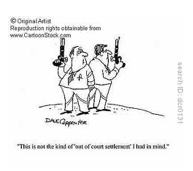 Check out the post in Riding the Third Wave regarding the virtues of settlement. Every lawyer knows that we ought to settle more cases. Its just the case we are preparing for trial at the moment that shouldn’t be settled.
Part of the problem is the need for urgency. Even if you get the spirit, the other side is unlikely to entertain a reasonable offer until time is up. After all, who knows what may turn up? Exactly!
CLT
Stirling Cooper Draper Pryce becomes an Equal Opportunity Employer.
Posted by Cliff Tuttle| March 27, 2012 | © 2026
No. 821
 In case you’ve been in Brazil, or in a coma, you know that Madmen is back. The two-hour premiere of Season 5 had stirling ratings. And the times in 1964, they were a-changing.
At the beginning of the episode, a civil rights march is in progress on the sidewalk in front of the Madison Avenue headquarters of our heroes. A competitor of Stirling Cooper Draper Pryce, located on another floor of the same building, has its own group of grown-up adolescents. They drop water bombs on the protesters and are soon caught red-handed. Of course, it made the papers.
In their mirth over their competition’s embarrassment, and in order to goad them, without the approval of the firm, Stirling and Draper run an ad declaring SCDP to be an Equal Opportunity Employer.
When everyone seems to have forgotten about the incident, one morning the waiting room at SCDP is filled with well-dressed black job applicants.
Lane Pryce, the Financial Officer who came by way of the Anglo merger of the old firm, takes charge. They are only looking for a secretary, he announces, so all of the men can leave. He will collect resumes from the women and contact qualified applicants for interviews. As the episode ends, that seems to defuse the situation.
However, there actually is a secretary shortage — Don Draper’s secretary died and budget problems are requiring the partners to share. The plot line suggests that we have not heard the last of it.
I once worked for an elderly lawyer who worried that a black temporary secretary sent over by the Bar Association Placement Service would offend the conservative clientele. He moved her to the back office to be out of sight. He needn’t have bothered. The other secretaries quickly introduced the newcomer to clients. Everybody — staff, lawyers, clients — got on fine. Sometimes we worry about nothing.
CLT
« go back — keep looking »
Welcome
CLIFF TUTTLE has been a Pennsylvania lawyer for over 45 years and (inter alia) is a real estate litigator and legal writer. The posts in this blog are intended to provide general information about legal topics of interest to lawyers and consumers with a Pittsburgh and Western Pennsylvania focus. However, this information does not constitute legal advice and there is no lawyer-client relationship created when you read this blog. You are encouraged to leave comments but be aware that posted comments can be read by others. If you wish to contact me in privacy, please use the Contact Form located immediately below this message. I will reply promptly and in strict confidence.
Recent Posts
- Sheriff Sales in the COVID-19 Era
- MORTGAGE FORECLOSURE: Cares Act creates gigantic opportunity for borrows under federally-backed and owned mortgages.
- PA Appellate Courts Schedule Arguments Using Electronic Media
- US Supreme Court holds that juries must render unanimous decisions in state criminal cases
- Signs of the Times — the future shortage of dentists.